


Woodworking Machinery Guide
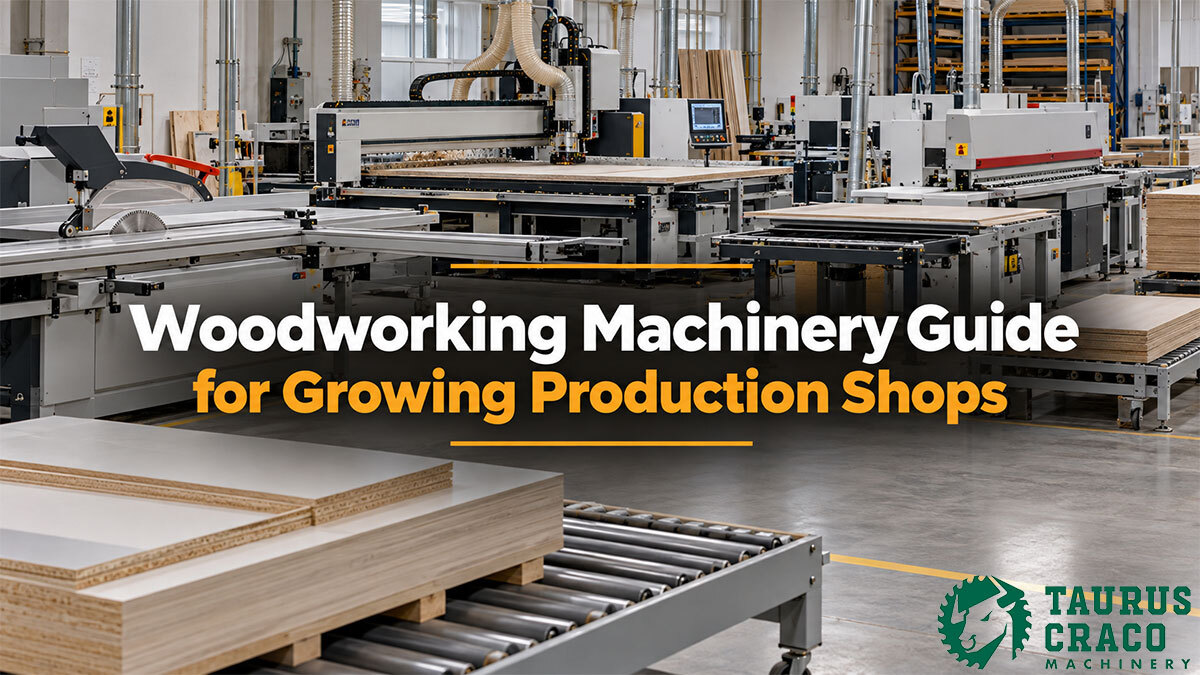
Growing a woodworking business eventually creates a problem that hand tools, entry-level equipment, and extra labour cannot solve: production capacity.
The right woodworking machinery allows a shop to process more material, produce more consistent components, reduce repetitive manual work, and build a production system capable of supporting larger orders.
But growth does not mean buying every machine available.
It means identifying the bottlenecks that limit output and investing in machinery that removes them in the correct order.
A cabinet manufacturer may benefit first from CNC machinery and an edgebander. A solid-wood furniture shop may gain more from better saws, planers, moulders, and sanding equipment. A high-volume operation may eventually need automated material handling, return conveyors, dust collection, and integrated production cells.
This guide explains how growing woodworking shops can plan machinery investments around production requirements instead of simply adding equipment whenever capacity becomes tight.
Quick Answer: What Machinery Does a Growing Woodworking Shop Need?
Most growing production shops build their equipment strategy around several core machinery categories:
- CNC machinery for automated cutting, routing, drilling, and component production
- Woodworking saws for panel sizing, ripping, crosscutting, and material preparation
- Edgebanders for professional panel-edge finishing
- Sanders for calibration, surface preparation, and finishing
- Drilling and boring machines for repeatable hardware and assembly holes
- Dust collection systems for machine extraction and shop cleanliness
- Material handling equipment for moving panels and components efficiently
- Feeders and return conveyors for reducing repetitive manual handling
The right machinery mix depends on what the shop manufactures, how many parts it produces, where labour is being consumed, and which process currently limits total output.
Why Growing Shops Need a Machinery Plan
Production growth often happens gradually.
A shop adds another employee.
Then another saw.
Then a larger sander.
Eventually the floor is full of equipment, but material still moves inefficiently and operators spend too much time loading, measuring, carrying, adjusting, and reworking parts.
A machinery plan looks at the entire workflow rather than individual machines.
Ask:
- Where does material enter the shop?
- Which operation creates the longest queue?
- Where are operators performing repetitive tasks manually?
- Which process generates the most rework?
- Which machine is running near full capacity?
- Where are parts being moved unnecessarily?
- Which process would prevent the business from accepting larger orders?
If you are still determining which equipment categories belong in your production environment, Taurus Craco's complete guide to woodworking machinery provides a broader overview of the primary equipment used in professional shops.
1. Start With Cutting and Material Preparation
Nearly every woodworking production process begins by converting raw material into accurately sized components.
This makes cutting equipment one of the first places to evaluate when production begins to grow.
The Taurus Craco woodworking saws category includes equipment for panel sizing, ripping, crosscutting, optimizing, and other cutting operations.
Common saw categories include:
- Beam saws
- Vertical saws
- Sliding table saws
- Single-blade rip saws
- Multi-blade and gang rip saws
- Optimizing crosscut saws
- Bandsaws
- Cutoff and mitre saws
A growing custom shop may still benefit from the flexibility of a sliding table saw, while a panel-processing operation may require more automated sizing equipment as sheet volume increases.
For example, the Fimal P3200AX Sliding Table Saw is one of the sliding table saw options available through Taurus Craco for professional cutting applications.
The important question is not simply, "Which saw is best?"
It is, "Which cutting process is slowing down everything that happens after it?"
2. Add CNC Machinery When Repeatability Becomes Critical
For many cabinet, furniture, closet, fixture, and millwork manufacturers, the biggest step in scaling production is the transition to CNC.
Woodworking CNC machines can automate operations such as:
- Panel cutting
- Nesting
- Routing
- Grooving
- Drilling
- Pocketing
- Profiling
- Machining hardware locations
A CNC does more than make parts faster.
It can create repeatable digital production.
Once a program is established correctly, the same component can be manufactured repeatedly with less dependence on manual measuring and layout.
When should a woodworking shop invest in CNC machinery?
A CNC investment becomes increasingly attractive when a shop produces repeated components, spends significant labour on manual routing or drilling, processes high volumes of sheet goods, or struggles to maintain consistency as order volume increases.
Growing shops should also consider whether their work is best suited to a flat-table nesting CNC or a pod-and-rail configuration. Taurus Craco's guide on how to choose the right CNC machine explains several of the production factors that should be evaluated before purchasing.
3. Edgebanding Can Become the Next Production Bottleneck
Adding CNC capacity can expose another problem.
You can now produce panels faster than you can finish them.
This is common in growing cabinet and panel-processing shops.
An automatic woodworking edgebander can combine multiple edge-finishing operations into a continuous production process.
Depending on the machine configuration, these operations may include:
- Pre-milling
- Adhesive application
- Edge feeding
- End trimming
- Top and bottom trimming
- Corner rounding
- Scraping
- Cleaning
- Buffing
For shops increasing cabinet and furniture production, an edgebander can reduce the amount of manual edge finishing required after panels leave the cutting or CNC department.
The OTT Tornado+ Edgebander, for example, is one of the compact production edgebanders offered through Taurus Craco.
4. Improve Surface Preparation Before Adding More Labour
Sanding often becomes an underestimated production constraint.
Adding employees with handheld sanders may temporarily increase output, but manual sanding becomes difficult to scale when hundreds of doors, panels, tabletops, or components must be processed consistently.
Industrial woodworking sanders can support:
- Panel calibration
- Stock removal
- Fine sanding
- Edge sanding
- Profile sanding
- Brush sanding
- Denibbing
- Texturing
Wide-belt sanding is particularly valuable when production volume requires consistent thickness or surface preparation across repeated components.
One current equipment example is the BOSS Storm Single Head Wide Belt Sander, designed for industrial sanding applications.
The goal is not simply to sand faster.
It is to reduce variability and prevent finishing departments from becoming overloaded as upstream machinery produces more components.
5. Do Not Ignore Drilling and Assembly Operations
A shop can have fast panel cutting and still lose hours during assembly.
Hardware drilling, dowel holes, shelf pins, hinge preparation, and connector locations all require repeatable accuracy.
Dedicated woodworking drilling machines can help automate repeated boring patterns and reduce the amount of manual positioning required during cabinet and furniture production.
This becomes increasingly important when product volume rises because small positioning errors repeated across hundreds of parts create expensive assembly problems.
6. Dust Collection Must Grow With the Machinery
More machines generally mean more chips, more fine dust, and greater extraction demand.
A dust system designed for a small shop may not adequately support a facility after CNC machines, sanders, saws, and moulders are added.
Woodworking dust collectors should be considered part of the production system rather than an accessory added after machinery installation.
When production capacity grows, evaluate:
- Required airflow at each machine
- Duct diameter and layout
- Static pressure
- Filter capacity
- Waste discharge
- Blast-gate control
- Future machinery additions
Dust accumulation can also affect maintenance requirements, which is why a structured woodworking machinery maintenance program becomes more important as a shop adds equipment.
7. Material Handling Becomes More Important as Output Increases
One of the biggest differences between a small woodworking shop and an efficient production facility is how material moves.
Operators should not spend a large percentage of each shift carrying panels from storage to a saw, from the saw to a CNC, from the CNC to an edgebander, and from the edgebander to assembly.
Wood material handling equipment can include:
- Vacuum lifters
- Panel storage systems
- Workstations
- Transfer systems
- Lift equipment
- Automated loading solutions
As production volume increases, reducing unnecessary handling can improve throughput even without increasing the cutting speed of the primary machine.
8. Use Feeders and Return Conveyors to Increase Machine Utilization
Some production machines still require substantial operator involvement after automation has been added.
An edgebander, sander, or shaper may process a part quickly, but the operator still has to retrieve it, reposition it, and run another edge or surface.
Feeders and return conveyors can reduce this repetitive movement by returning processed components to the operator or feeding material through equipment at a controlled rate.
This can allow one operator to manage a process that previously required more manual movement or a second employee.
Woodworking Machinery Investment Priorities by Growth Stage
| Growth Stage | Typical Machinery Priority | Main Objective |
|---|---|---|
| Small Professional Shop | Saws, jointers, planers, sanders | Improve basic production capacity and accuracy |
| Growing Cabinet Shop | CNC, edgebander, drilling equipment | Automate repeat panel production |
| Growing Furniture or Millwork Shop | CNC, moulders, sanders, material handling | Increase repeatability and finishing capacity |
| High-Volume Production Shop | Automated handling, conveyors, return systems | Reduce labour between machines |
| Automated Manufacturing Facility | Integrated production cells and storage | Optimize complete material flow |
New vs Used Machinery for a Growing Shop
Growth does not necessarily require purchasing every machine new.
Used machinery can sometimes provide a cost-effective way to add capacity, particularly for mature mechanical processes where the required capability has not changed dramatically.
New machinery may be more attractive when a shop needs current automation, software integration, advanced controls, higher throughput, or manufacturer support.
The Taurus Craco comparison of new vs used woodworking machinery provides additional considerations for deciding between the two options.
How Much Should a Growing Shop Invest?
There is no single correct equipment budget.
A growing shop should invest based on the value of the bottleneck being removed.
Consider:
- Current production volume
- Backlog and lost orders
- Labour hours required per component
- Material waste
- Rework
- Setup time
- Machine utilization
- Expected future volume
A machine that removes several hours of repetitive work every shift may justify a larger investment than a less expensive machine that improves a process used only occasionally.
For broader budgeting guidance, see How Much Does Woodworking Machinery Cost?
What Is the Best First Machinery Upgrade for a Growing Shop?
The best first upgrade is the machine that removes the shop's most expensive production constraint.
For one cabinet manufacturer, that may be a CNC router.
For another, it may be an edgebander.
For a solid-wood shop, it could be an optimizing saw, moulder, planer, or wide-belt sander.
For an already well-equipped facility, the next improvement may not be another processing machine at all. It may be material handling or return automation.
Taurus Craco's guide to the best woodworking machinery for manufacturing shops provides additional examples of equipment that can have a significant production impact.
Woodworking Machinery Buying Checklist
Before purchasing additional machinery, evaluate the following:
- What is our current production bottleneck?
- How many parts must we produce per shift?
- Which materials are we processing?
- What part sizes must the machine handle?
- How much floor space is available?
- Will upstream machines overload downstream processes?
- Do we have adequate dust collection?
- Do we have sufficient compressed air and electrical capacity?
- How will material be loaded and unloaded?
- What tooling and consumables are required?
- What training will operators need?
- How easily can the system support future growth?
Common Machinery Expansion Mistakes
- Buying equipment only because production is busy
- Automating one process while ignoring the next bottleneck
- Choosing machinery solely by purchase price
- Ignoring material handling requirements
- Underestimating dust collection demand
- Failing to plan machine placement before delivery
- Not budgeting for tooling, installation, training, and utilities
- Buying capacity that cannot integrate with the existing workflow
- Waiting until current equipment is completely overloaded before planning expansion
Final Thoughts
Growing a woodworking production shop is not about collecting more machines.
It is about building a production system.
The most effective machinery investments connect cutting, CNC machining, drilling, edgebanding, sanding, material handling, dust collection, and assembly into a workflow where one process does not continuously wait for another.
Start with the largest constraint.
Measure what it costs the business.
Then select machinery that improves capacity while supporting the next stage of growth.
Taurus Craco Machinery supplies industrial woodworking machinery and equipment for cabinet shops, furniture manufacturers, architectural millwork operations, door producers, panel processors, and other professional woodworking businesses looking to expand production capacity.
Frequently Asked Questions
What woodworking machinery should a growing cabinet shop buy first?
The answer depends on the shop's current bottleneck. CNC machines, panel saws, edgebanders, drilling equipment, and dust collection systems are common priorities for growing cabinet manufacturers because they automate several labour-intensive panel-processing operations.
When is a woodworking shop ready for CNC machinery?
A shop may be ready for CNC machinery when repeated cutting, routing, drilling, or component production is consuming significant labour, limiting capacity, or creating consistency problems. CNC becomes especially valuable when the same parts are produced repeatedly.
How can woodworking machinery increase production capacity?
Industrial woodworking machinery can automate repetitive operations, improve feed rates, reduce setup time, increase repeatability, decrease manual handling, and allow more components to move through the shop during each shift.
Should a growing shop buy new or used woodworking equipment?
Both can be appropriate. New equipment may offer newer automation, controls, software integration, warranties, and manufacturer support. Used machinery can reduce initial investment when the equipment is properly inspected and still matches the required production process.
How should a woodworking shop plan future machinery purchases?
Track production bottlenecks, machine utilization, labour hours, material movement, rework, backlog, and expected sales growth. Machinery purchases should be prioritized according to which constraint has the greatest impact on throughput, quality, and profitability.