


How Much Does Woodworking Machinery Cost?
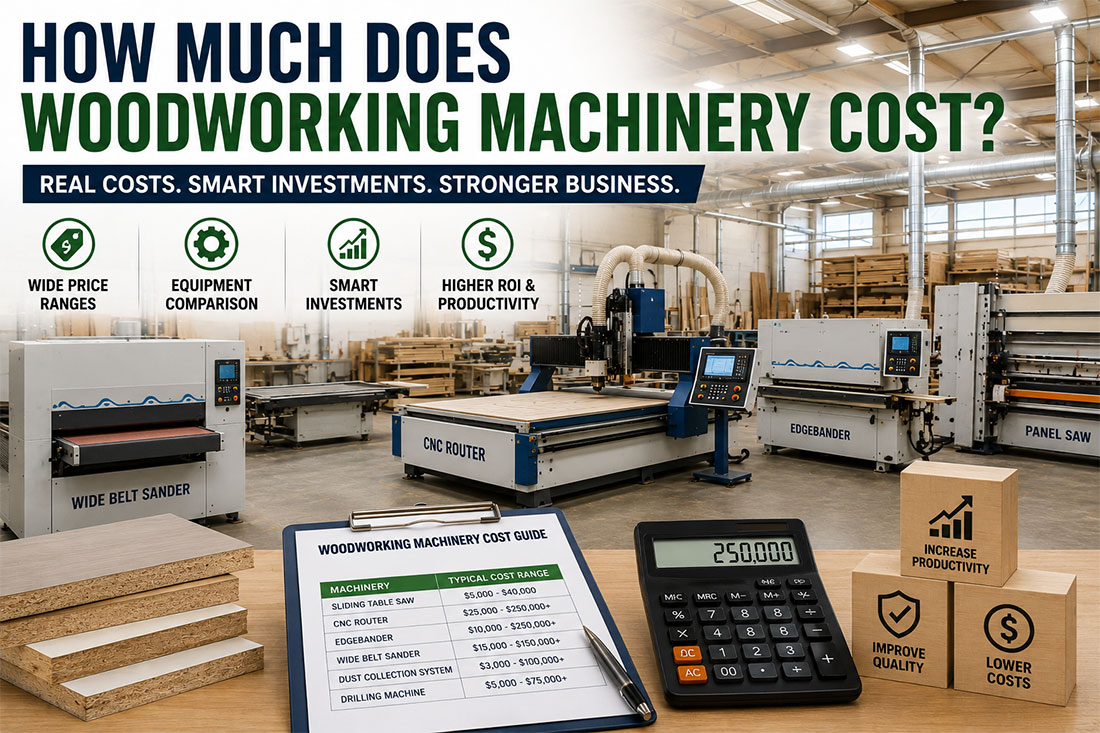
Woodworking machinery costs vary dramatically depending on the type of equipment, production requirements, automation level, and whether you purchase new woodworking machinery or used woodworking machinery.
A small cabinet shop may spend less than $50,000 on essential equipment.
A growing production facility may invest several hundred thousand dollars.
Large manufacturing operations often invest millions into woodworking machinery equipment, CNC automation, material handling systems, and production workflows.
The important question is not simply "How much does woodworking machinery cost?"
The better question is: How much woodworking machinery does your business actually need?
Quick Answer
Typical woodworking machinery investments often fall within these ranges:| Shop Type | Typical Investment |
Hobby / Small Shop |
$5,000 - $25,000 |
Startup Cabinet Shop |
$25,000 - $100,000 |
Growing Woodworking Business |
$100,000 - $500,000 |
Production Manufacturing Shop |
$500,000 - $2M+ |
Large Automated Facility |
$2M+ |
The final cost depends on machinery type, production volume, tooling requirements, and automation goals.
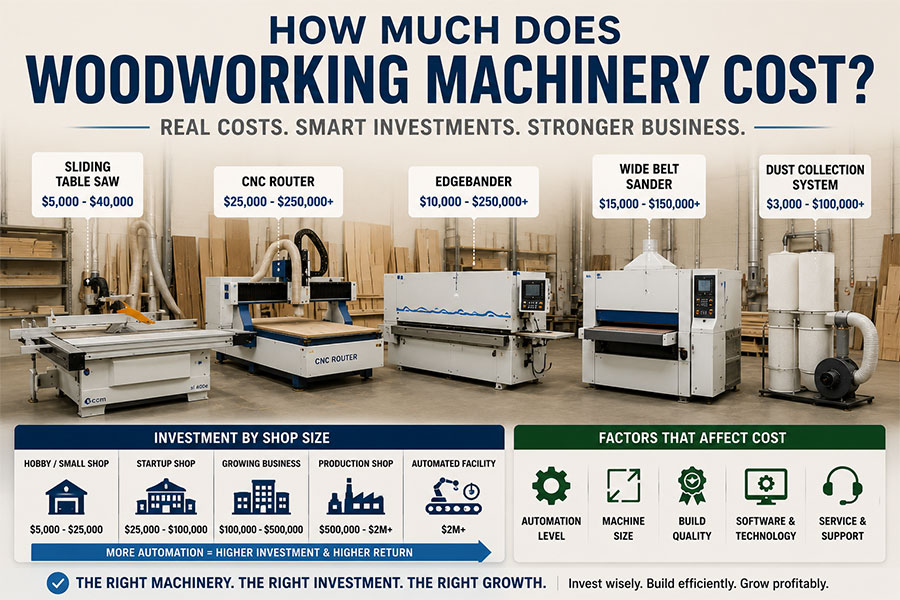
Woodworking Machinery Cost Overview
| Machinery Type | Typical Cost Range |
Sliding Table Saw |
$5,000 - $40,000 |
Panel Saw |
$20,000 - $150,000+ |
CNC Router |
$25,000 - $250,000+ |
CNC Machining Center |
$75,000 - $500,000+ |
Edgebander |
$10,000 - $250,000+ |
Wide Belt Sander |
$15,000 - $150,000+ |
Dust Collection System |
$3,000 - $100,000+ |
Drilling & Boring Machine |
$5,000 - $75,000+ |
Material Handling Systems |
$10,000 - $500,000+ |
These figures vary significantly based on manufacturer, size, features, and automation capabilities.
Why Woodworking Machinery Prices Vary So Much
Two CNC routers can look similar.
One might cost $40,000.
Another might cost $250,000.
The difference often comes down to:
✓ Automation
✓ Production speed
✓ Machine size
✓ Software integration
✓ Tool-changing capability
✓ Build quality
✓ Service support
✓ Manufacturing country
The cheapest machine is rarely the cheapest long-term solution.
Downtime, repairs, slower production, and limited capabilities often create hidden costs.
How Much Does CNC Machinery Cost?
CNC machinery is often the largest investment for woodworking businesses.
It is also one of the highest-return investments.
CNC Router Pricing
| CNC Router Type | Typical Cost |
Entry-Level CNC Router |
$25,000 - $60,000 |
Production CNC Router |
$60,000 - $150,000 |
Advanced CNC Router |
$150,000 - $300,000+ |
CNC Machining Center Pricing
| CNC Machining Center Type | Typical Cost |
Basic Machining Center |
$75,000 - $150,000 |
Mid-Level Production Center |
$150,000 - $300,000 |
High-End Production Center |
$300,000 - $500,000+ |
For many cabinet shops and millwork businesses, CNC machinery produces the largest productivity improvement.
How Much Does An Edgebander Cost?
Edgebanders are among the most important machines in modern cabinet production.
Pricing varies widely.
Edgebander Cost Breakdown
| Edgebander Type | Typical Cost |
Manual / Compact Edgebander |
$5,000 - $15,000 |
Entry Automatic Edgebander |
$15,000 - $50,000 |
Production Edgebander |
$50,000 - $150,000 |
Industrial Edgebander |
$150,000 - $300,000+ |
Many cabinet shops find that an edgebander delivers one of the strongest returns on investment after CNC machinery.
Benefits include:
✓ Faster production
✓ Better finish quality
✓ Reduced labor
✓ Greater consistency
How Much Does A Dust Collection System Cost?
Dust collection systems is often overlooked during budgeting.
It shouldn't be.
A proper dust collection system protects workers, machinery, and finished products.
| Dust Collection Type | Typical Cost |
Small Shop System |
$3,000 - $10,000 |
Mid-Sized Shop System |
$10,000 - $40,000 |
Production Facility System |
$40,000 - $100,000+ |
Many businesses underestimate dust collection costs during expansion planning.
New Woodworking Machinery vs Used Woodworking Machinery
One of the biggest factors affecting cost is whether you buy new woodworking machinery or used woodworking machinery.
New Woodworking Machinery
Benefits include:
✓ Latest technology
✓ Manufacturer warranty
✓ Better automation
✓ Longer equipment lifespan
Potential drawback:
X Higher purchase price
Used Woodworking Machinery
Benefits include:
✓ Lower acquisition cost
✓ Faster ROI
✓ Access to premium equipment
Potential drawbacks:
X Older technology
X Limited warranty
X Variable condition
New vs Used Woodworking Machinery Cost Comparison
| Machinery Type | New Equipment | Used Equipment |
Sliding Table Saw |
$10,000 - $40,000 |
$3,000 - $20,000 |
CNC Router |
$25,000 - $250,000+ |
$10,000 - $150,000 |
Edgebander |
$10,000 - $250,000+ |
$5,000 - $100,000 |
Wide Belt Sander |
$15,000 - $150,000+ |
$5,000 - $75,000 |
Many growing shops use a combination of both.
Hidden Costs Many Buyers Forget
The machine itself is only part of the investment.
Additional costs often include:
- Tooling
- Freight
- Installation
- Training
- Dust collection
- Electrical upgrades
- Software
- Maintenance
- Material handling
These expenses can add 10-30% or more to the overall project cost.
Common Buying Mistakes
X Budgeting only for the machine
X Ignoring tooling costs
X Forgetting electrical requirements
X Underestimating installation expenses
X Focusing only on purchase price
X Ignoring service support
The total cost of ownership matters more than the sticker price.
Typical Woodworking Machinery Investment By Shop Size
Many business owners want a realistic budget benchmark.
The following ranges are common.
| Shop Type | Estimated Investment | Growth Potential |
Startup Cabinet Shop |
$25,000 - $100,000 |
Entry Level |
Small Production Shop |
$100,000 - $250,000 |
Moderate |
Growing Manufacturer |
$250,000 - $750,000 |
High |
Regional Manufacturer |
$750,000 - $2M+ |
Very High |
Automated Facility |
$2M+ |
Maximum |
The goal should not be spending more.
The goal should be removing bottlenecks.
Which Woodworking Machinery Delivers The Best Value?
Some machines consistently produce strong returns.
| Machinery | Typical Business Impact |
CNC Router |
██████████ |
Edgebander |
█████████ |
Panel Saw |
████████ |
Dust Collection |
███████ |
Wide Belt Sander |
██████ |
Drilling Equipment |
█████ |
The highest-value investment is usually the machine that solves the most expensive production problem.
Industries That Invest In Woodworking Machinery
Woodworking machinery equipment is used throughout many industries.
| Industry | Common Machinery |
Cabinet Manufacturing |
CNC, Edgebanders, Panel Saws |
Closet Manufacturing |
CNC, Boring Machines |
Architectural Millwork |
CNC, Sanding Equipment |
Office Furniture |
CNC Routers, Drilling Systems |
Retail Fixtures |
CNC Machinery, Edgebanders |
Hospitality Millwork |
CNC Production Equipment |
Custom Furniture |
CNC Routers, Sanding Systems |
Each industry has different requirements, but all rely on efficient production equipment.
Buying Considerations Before Purchasing Woodworking Machinery
Before buying woodworking machinery, ask:
| Question | Why It Matters |
What is our biggest bottleneck? |
Prioritizes purchases |
How much production volume do we have? |
Determines machine size |
What is our growth plan? |
Prevents underbuying |
Do we have operator capacity? |
Impacts implementation |
What tooling is required? |
Affects total cost |
Is service available locally? |
Reduces downtime |
These questions often matter more than the machine price itself.
Benefits Of Investing In Quality Woodworking Machinery
✓ Increased production capacity
✓ Improved consistency
✓ Reduced labor costs
✓ Better product quality
✓ Less material waste
✓ Higher profitability
✓ Faster turnaround times
✓ Improved competitiveness
Quality woodworking machinery should be viewed as a long-term business asset.
Final Thoughts
Woodworking machinery costs can range from a few thousand dollars to several million depending on the size of the operation and production goals.
For most businesses, the smartest approach is not buying the cheapest equipment.
It is buying machinery that solves bottlenecks, improves efficiency, and supports future growth.
Many manufacturers work with suppliers such as Taurus Craco Machinery to evaluate new woodworking machinery, used woodworking machinery, CNC equipment, edgebanders, dust collection systems, and production solutions that align with their business objectives and budget.
FAQ
How much does woodworking machinery cost for a cabinet shop?
Most startup cabinet shops invest between $25,000 and $100,000, while growing production shops often invest significantly more.
Is used woodworking machinery worth buying?
Yes. Used woodworking machinery can provide excellent value when purchased from a reputable supplier and properly inspected.
What is the most expensive woodworking machinery?
CNC machining centers, automated production systems, and integrated manufacturing lines are typically among the most expensive woodworking machinery investments.
Should I buy new or used woodworking machinery?
Both options can make sense. The decision depends on budget, production requirements, automation needs, and long-term growth plans.
What woodworking machinery delivers the highest ROI?
For many manufacturers, CNC routers and edgebanders provide the strongest return because they reduce labor, improve consistency, and increase production capacity.