


Woodworking Machinery Maintenance Checklist

Woodworking machinery maintenance is one of the most important investments a woodworking business can make. Whether you operate CNC machinery, panel saws, edgebanders, wide belt sanders, dust collectors, or other woodworking equipment, routine maintenance helps reduce downtime, extend machine life, improve product quality, and protect your investment.
The most expensive woodworking machinery isn't always the one that costs the most.
It's the one that's sitting idle.
Unexpected downtime creates missed deadlines.
Delayed customer orders.
Lost production.
Higher labour costs.
Preventative maintenance helps avoid these problems before they happen.
The best woodworking manufacturers don't wait for equipment to fail.
They maintain it consistently.
Quick Answer
A proper woodworking machinery maintenance program should include:
✓ Daily cleaning
✓ Lubrication of moving components
✓ Tooling inspections
✓ Belt and chain inspections
✓ Dust collection maintenance
✓ Air system checks
✓ Electrical inspections
✓ Scheduled servicing
Following a structured maintenance checklist helps maximize machine performance, reduce costly repairs, and increase the lifespan of woodworking machinery.
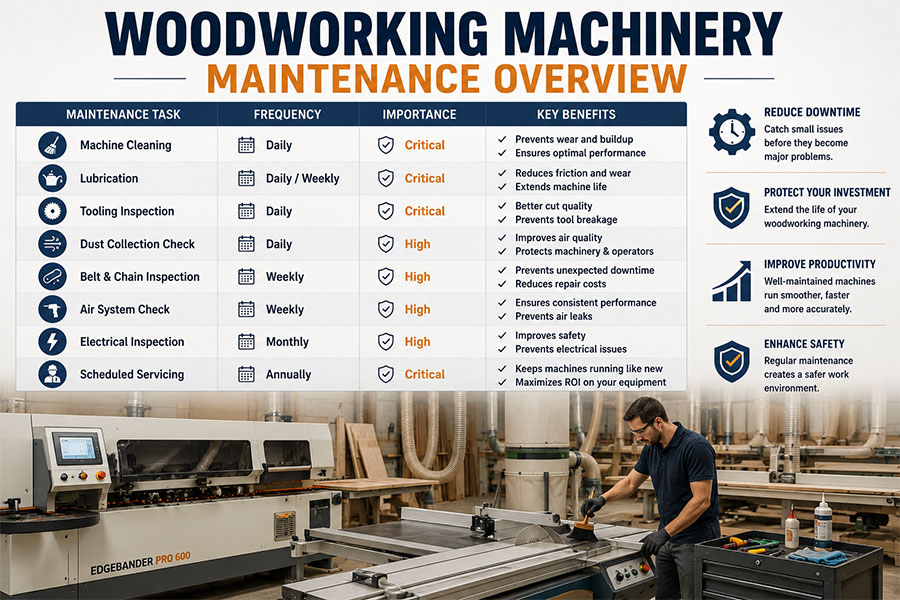
Woodworking Machinery Maintenance Overview
Maintenance Task |
Frequency |
Importance |
Machine Cleaning |
Daily |
Critical |
Lubrication |
Daily / Weekly |
Critical |
Tooling Inspection |
Daily |
Critical |
Dust Collection Check |
Daily |
High |
Belt Inspection |
Weekly |
High |
Air Pressure Check |
Weekly |
High |
Electrical Inspection |
Monthly |
High |
Professional Service |
Annually |
Critical |
Small maintenance tasks performed regularly prevent major repairs later.
Why Woodworking Machinery Maintenance Matters
Woodworking machinery operates under demanding conditions.
Dust.
Vibration.
Heat.
Continuous production.
Without routine maintenance, even the highest-quality woodworking equipment begins to lose performance.
Poor maintenance often leads to:
- Reduced accuracy
- Poor finish quality
- Increased downtime
- Premature component failure
- Higher operating costs
Benefits Of Preventative Maintenance
✓ Increased machine lifespan
✓ Better production quality
✓ Reduced downtime
✓ Lower repair costs
✓ Improved operator safety
✓ Higher production efficiency
✓ Better return on investment
Maintenance is one of the lowest-cost ways to improve profitability.
Daily Woodworking Machinery Maintenance
Daily inspections require very little time.
Yet they often prevent the biggest problems.
Daily Maintenance Checklist
✓ Remove sawdust and debris
✓ Inspect safety guards
✓ Check emergency stop functions
✓ Inspect cutting tools
✓ Check dust extraction points
✓ Verify lubrication levels
✓ Listen for unusual noises
✓ Inspect air hoses and fittings
Operators should never assume yesterday's machine condition is today's condition.
Weekly Maintenance Checklist
Weekly inspections focus on wear items.
These components gradually deteriorate over time.
Weekly Tasks
- Check drive belts
- Inspect bearings
- Tighten loose hardware
- Check pneumatic systems
- Clean filters
- Inspect guide rails
- Verify machine calibration
These inspections often identify problems before they become expensive failures.
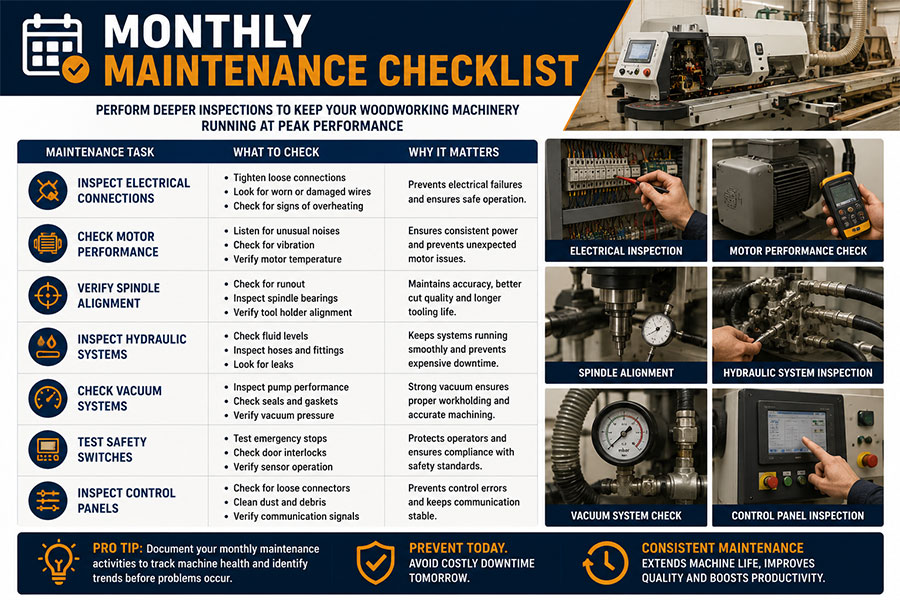
Monthly Maintenance Checklist
Monthly maintenance includes deeper inspections.
This is an ideal time to verify overall machine health.
Monthly Maintenance
✓ Inspect electrical connections
✓ Check motor performance
✓ Verify spindle alignment
✓ Inspect hydraulic systems
✓ Check vacuum systems
✓ Test safety switches
✓ Inspect control panels
Monthly inspections reduce the likelihood of unexpected production interruptions.
CNC Machinery Maintenance
CNC machinery represents one of the largest investments in most woodworking facilities.
Routine maintenance protects that investment.
CNC Maintenance Checklist
Maintenance Item |
Recommended Frequency |
Clean Machine Bed |
Daily |
Inspect Router Bits |
Daily |
Clean Linear Rails |
Daily |
Lubricate Moving Components |
Weekly |
Inspect Tool Holders |
Weekly |
Check Vacuum Table |
Weekly |
Verify Machine Calibration |
Monthly |
Inspect Spindle |
Monthly |
Well-maintained CNC machinery produces:
✓ Better accuracy
✓ Better surface finish
✓ Longer tooling life
✓ Faster production
✓ Lower operating costs
Panel Saw Maintenance
Panel saws process thousands of cuts every week.
Blade condition and alignment directly affect production quality.
Recommended Maintenance
- Inspect saw blades
- Verify blade alignment
- Clean guide systems
- Check scoring blades
- Inspect drive belts
- Remove accumulated dust
A poorly maintained panel saw increases material waste quickly.
Edgebander Maintenance
Edgebanders rely on multiple systems working together.
Glue.
Pressure.
Trimming.
Buffing.
When one system declines, finished edge quality suffers.
Edgebander Maintenance
✓ Clean glue pots
✓ Remove adhesive buildup
✓ Inspect trimming knives
✓ Replace worn scraper blades
✓ Check pressure rollers
✓ Clean buffing stations
Consistent maintenance produces cleaner edges and fewer callbacks.
Dust Collection Maintenance
Dust collection protects both machinery and operators.
Reduced airflow creates problems throughout the shop.
Dust Collection Checklist
Maintenance Item |
Frequency |
Empty Collection Bags |
Daily |
Inspect Filters |
Weekly |
Check Flexible Hose |
Weekly |
Inspect Blast Gates |
Monthly |
Check Motor Belts |
Monthly |
Inspect Impeller |
Quarterly |
Clean airflow improves every woodworking machine connected to the system.
Tooling Maintenance
Many machining problems are actually tooling problems.
Worn tooling increases:
- Machine load
- Heat
- Vibration
- Material waste
- Poor finish quality
Tooling Best Practices
✓ Inspect tooling daily
✓ Replace damaged cutters
✓ Store tooling properly
✓ Clean collets
✓ Monitor tool wear
Good tooling maintenance improves overall machinery performance.
Common Signs Maintenance Is Needed
Machines often provide warning signs before failure.
Ignoring them usually increases repair costs.
Warning Signs
Symptom |
Possible Cause |
Excessive vibration |
Bearing wear |
Burn marks |
Dull tooling |
Poor cut quality |
Machine alignment |
Increased noise |
Mechanical wear |
Reduced airflow |
Dirty filters |
Inconsistent dimensions |
Calibration issue |
Small issues become large repairs if ignored.
Which Maintenance Tasks Have The Biggest Impact?
Some maintenance activities provide greater value than others.
Maintenance Activity |
Production Impact |
Daily Cleaning |
██████████ |
Tooling Maintenance |
█████████ |
Dust Collection |
█████████ |
Lubrication |
████████ |
Machine Calibration |
███████ |
Electrical Inspection |
██████ |
Daily cleaning and tooling inspections often provide the fastest return.
Common Maintenance Mistakes
What Not To Do
X Waiting until machinery fails
X Ignoring unusual noises
X Running worn tooling
X Skipping lubrication
X Ignoring dust buildup
X Delaying filter replacement
X Overlooking calibration
X Using incorrect lubricants
Preventative maintenance is always less expensive than emergency repairs.
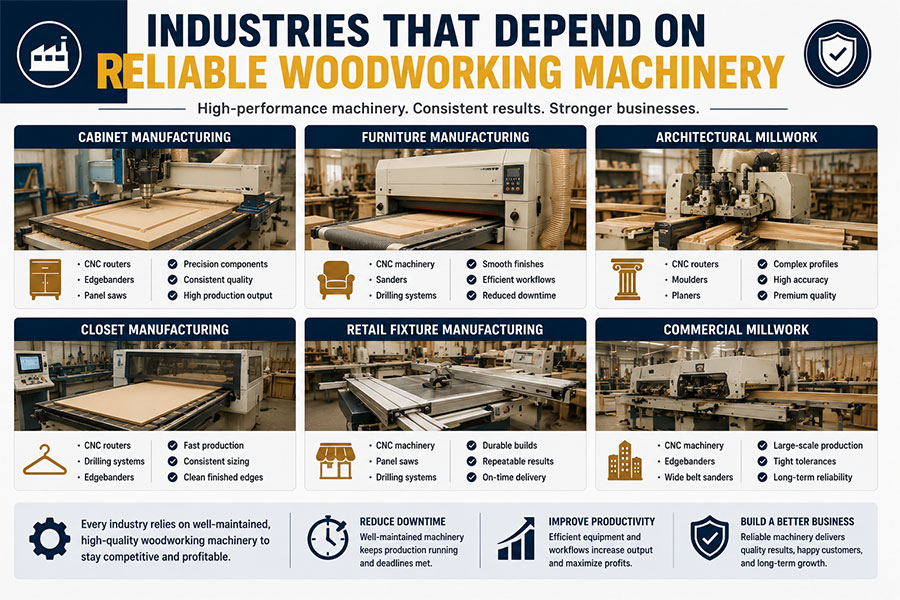
Industries That Depend On Reliable Woodworking Machinery
Industry |
Typical Machinery |
Cabinet Manufacturing |
CNC routers, edgebanders, panel saws |
Furniture Manufacturing |
CNC machinery, sanders |
Architectural Millwork |
CNC equipment, moulders |
Closet Manufacturing |
CNC routers, drilling systems |
Retail Fixture Manufacturing |
CNC machinery, panel processing |
Commercial Millwork |
Integrated production lines |
Every woodworking industry benefits from consistent machinery maintenance.
Buying Considerations For Machinery Maintenance
Before creating a maintenance program, consider:
Question |
Why It Matters |
What machinery do you own? |
Determines maintenance schedule |
What is the production volume? |
Impacts inspection frequency |
Are OEM maintenance recommendations available? |
Improves reliability |
Are replacement parts stocked? |
Reduces downtime |
Is preventative maintenance documented? |
Improves consistency |
Are operators properly trained? |
Prevents avoidable damage |
The best maintenance program is the one that is consistently followed.
Benefits Of A Preventative Maintenance Program
✓ Reduced downtime
✓ Lower repair costs
✓ Longer machinery lifespan
✓ Better production quality
✓ Improved workplace safety
✓ Increased productivity
✓ Lower operating costs
✓ Better return on machinery investment
A simple maintenance checklist can save thousands in avoidable repair costs each year.
Final Thoughts
Woodworking machinery maintenance should never be viewed as optional.
It is one of the most valuable investments a woodworking business can make.
Routine inspections, cleaning, lubrication, tooling maintenance, and scheduled servicing help maximize machine life while reducing downtime and improving product quality.
The most successful woodworking manufacturers understand that consistent maintenance protects both production and profitability.
Many cabinet shops, furniture manufacturers, millwork companies, and industrial woodworking businesses work with Taurus Craco Machinery for new woodworking machinery, CNC machinery, replacement equipment, and expert support to help keep production running efficiently for years to come.
FAQ
How often should woodworking machinery be maintained?
Basic cleaning and inspections should be performed daily, while more detailed maintenance should follow weekly, monthly, and annual schedules depending on the equipment.
What is the most important woodworking machinery maintenance task?
Daily cleaning and tooling inspections are among the most important because they help prevent premature wear and unexpected downtime.
Why is preventative maintenance important for CNC machinery?
Preventative maintenance improves accuracy, extends machine life, reduces downtime, protects tooling, and lowers long-term operating costs.
Does dust collection affect woodworking machinery performance?
Yes. Proper dust collection improves machine efficiency, protects moving components, reduces maintenance requirements, and creates a cleaner, safer work environment.
Who should perform woodworking machinery maintenance?
Daily maintenance is often completed by machine operators, while more advanced servicing should be carried out by trained maintenance personnel or qualified machinery technicians following manufacturer recommendations