


What Is Woodworking Machinery? Complete Guide
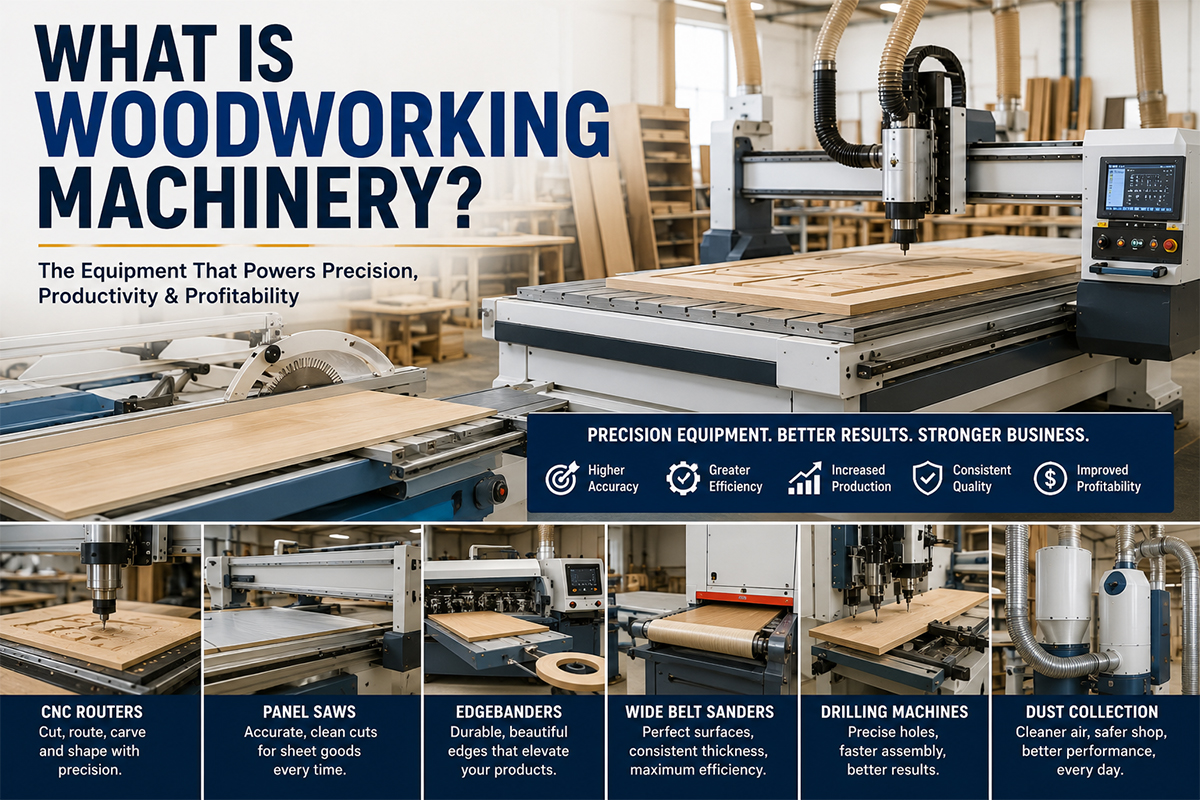
Woodworking machinery includes the industrial machines and equipment used to cut, shape, drill, sand, edge, profile, finish, and manufacture wood-based products. From small cabinet shops to large furniture factories, woodworking machinery helps businesses improve accuracy, increase output, reduce labour requirements, and produce consistent results.
Modern woodworking is no longer built around manual tools alone.
Production demands are higher.
Customers expect tighter tolerances.
Delivery times are shorter.
And material costs continue to matter.
The right woodworking equipment helps manufacturers meet these demands while building a more efficient and profitable operation.
Quick Answer
Woodworking machinery refers to powered equipment used to process solid wood, plywood, MDF, particleboard, laminates, and other wood-based materials.
Common examples include:
✓ CNC routers
✓ Panel saws
✓ Edgebanders
✓ Wide belt sanders
✓ Planers
✓ Moulders
✓ Drilling machines
✓ Dust collectors
✓ Finishing equipment
Industrial woodworking machinery allows businesses to manufacture cabinets, furniture, architectural millwork, closets, retail fixtures, doors, flooring, and custom wood products with greater speed, precision, and consistency.
Woodworking Machinery Overview
| Machinery Type | Primary Function |
Common Application |
CNC Router |
Automated cutting and routing |
Cabinets and custom components |
Panel Saw |
Accurate sheet cutting |
Plywood, MDF, and laminated panels |
Edgebander |
Applies finished edges |
Cabinet and furniture panels |
Wide Belt Sander |
Sands and calibrates surfaces |
Panels, doors, and solid wood |
Moulder |
Creates profiles and shapes |
Trim, mouldings, and flooring |
Planer |
Reduces material thickness |
Solid wood preparation |
Drilling Machine |
Creates precise holes |
Cabinets and furniture assembly |
Dust Collector |
Removes airborne dust |
Shop-wide dust control |
Each machine solves a different production challenge.
The best equipment mix depends on what your shop produces, how much you manufacture, and where delays currently occur.
What Is Woodworking Machinery?
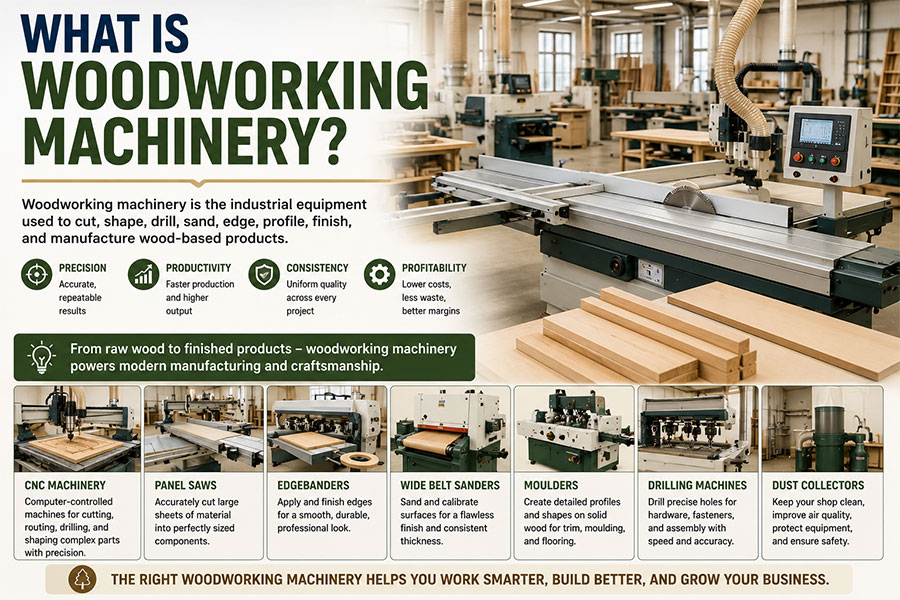
Woodworking machinery is the category of machines used to transform raw wood and sheet goods into finished or semi-finished components.
These machines can perform operations such as:
- Cutting
- Routing
- Drilling
- Sanding
- Planing
- Moulding
- Edgebanding
- Boring
- Carving
- Finishing
Some machines complete one specialized task.
Others combine multiple operations into one automated production system.
For example, a traditional panel saw cuts sheets into parts, while a CNC nesting machine can cut, drill, groove, and label multiple components from a single sheet.
That difference can dramatically affect production time.
How Does Woodworking Machinery Work?
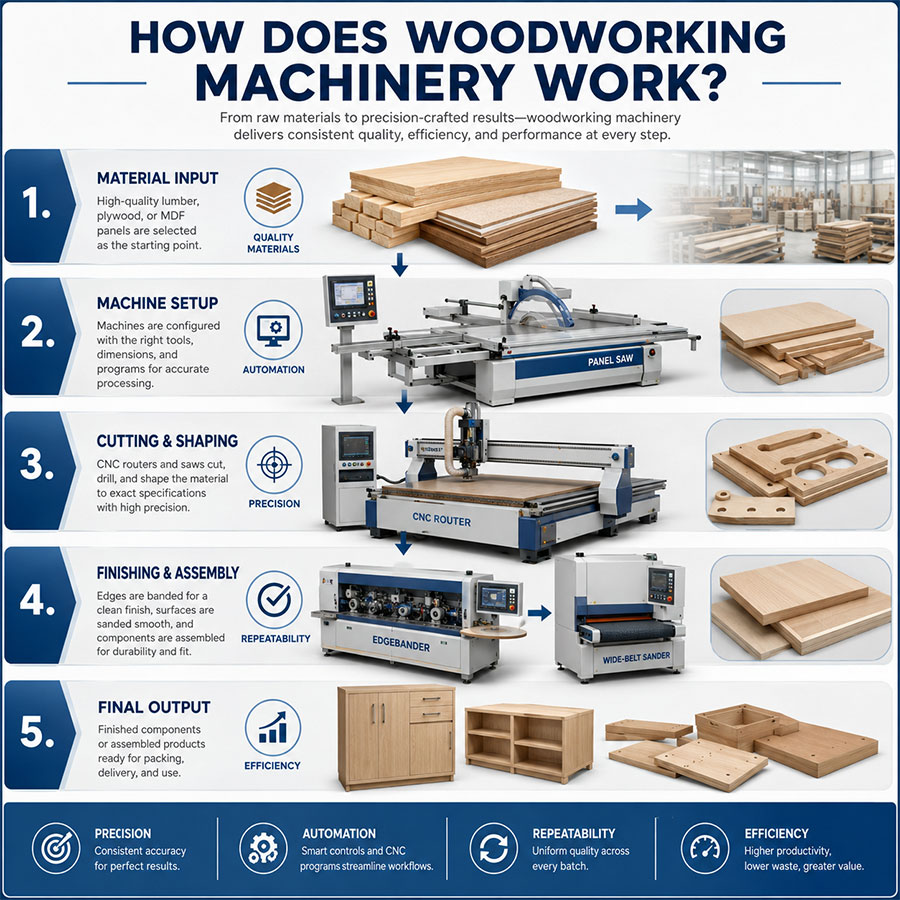
Woodworking machinery uses electric motors, cutting tools, abrasives, pressure systems, conveyors, computer controls, or a combination of these technologies to process material.
The exact workflow depends on the machine.
Material Preparation
Solid wood may be jointed, planed, or cut to size before machining.
Sheet goods may be loaded directly onto a panel saw or CNC machine.
Machine Setup
Operators install the correct blades, cutters, sanding belts, drill bits, or tooling.
Machine settings are adjusted for:
- Material thickness
- Cut depth
- Feed speed
- Tool speed
- Finished dimensions
Machining
The equipment performs the required operation.
This may be manually controlled, semi-automated, or fully computer controlled.
Inspection
Finished parts are checked for:
✓ Correct dimensions
✓ Edge quality
✓ Surface finish
✓ Hole placement
✓ Consistency
Proper setup and quality tooling are essential for dependable results.
Types of Woodworking Machinery
Professional woodworking shops use different machinery depending on their products and production volume.
CNC Woodworking Machinery
CNC woodworking machinery uses computer numerical control to automate cutting, routing, drilling, engraving, and shaping.
Common CNC equipment includes:
- CNC routers
- Nesting machines
- CNC drilling machines
- CNC machining centres
- Point-to-point machines
CNC machinery is ideal for shops that need repeatable parts, complex designs, faster production, and lower material waste.
Panel Saws
Panel saws cut large sheets of material into smaller components.
They are commonly used with:
- Plywood
- MDF
- Particleboard
- Melamine
- Laminated panels
Industrial panel saws provide accurate, repeatable cuts while reducing manual material handling.
They are especially valuable in cabinet, closet, and furniture production.
Edgebanders
Edgebanders apply a finished strip to the exposed edges of panels.
The process may include:
✓ Glue application
✓ Edge placement
✓ Pressure rolling
✓ End trimming
✓ Top and bottom trimming
✓ Scraping
✓ Buffing
A high-quality edgebander produces clean, durable edges that improve both appearance and product life.
Wide Belt Sanders
Wide belt sanders process large surfaces quickly and consistently.
They may be used to:
- Calibrate panel thickness
- Remove machining marks
- Prepare surfaces for finishing
- Sand cabinet doors
- Process solid wood panels
Compared with handheld sanding, wide belt machinery delivers far more consistent results.
Moulders
Moulders cut detailed profiles into solid wood.
They are commonly used to produce:
- Crown moulding
- Baseboards
- Trim
- Flooring
- Door components
- Architectural profiles
Industrial moulders can process material continuously, making them ideal for higher-volume production.
Planers and Jointers
Planers reduce material to a consistent thickness.
Jointers create a flat face and straight edge.
Together, these machines prepare solid wood for accurate machining and assembly.
They remain essential in furniture, millwork, flooring, and custom woodworking operations.
Drilling and Boring Machines
Drilling machinery creates accurate holes for hardware and assembly.
Applications include:
- Cabinet hinges
- Shelf pins
- Dowel construction
- Confirmat screws
- Furniture connectors
- Closet systems
Multi-spindle drilling machines can produce several holes at once, significantly improving assembly speed.
Dust Collectors
Dust collectors remove sawdust, chips, and fine particles from machinery and work areas.
A properly designed system helps:
✓ Protect machine components
✓ Improve visibility
✓ Reduce cleanup
✓ Support air quality
✓ Lower fire risk
✓ Create a safer workplace
Dust collection is not a secondary accessory.
It is part of the production system.
Woodworking Equipment vs Hand Tools
Both have a place in professional woodworking.
| Feature | Woodworking Machinery |
Hand Tools |
Production Speed |
High |
Low |
Repeatability |
Excellent |
Operator dependent |
Accuracy |
High |
Skill dependent |
Production Volume |
Medium to high |
Low |
Labour Requirements |
Lower per part |
Higher per part |
Custom Detail Work |
Good |
Excellent |
Scalability |
Strong |
Limited |
Hand tools remain useful for fitting, adjustments, repairs, and detailed custom work.
Machinery is better suited to repeatable production.
Benefits of Industrial Woodworking Machinery
Businesses invest in woodworking equipment because it improves the entire production process.
Higher Productivity
Machinery completes repetitive operations faster than manual methods.
Better Accuracy
Precision guides, digital controls, and automated positioning reduce dimensional errors.
Consistent Quality
Every component can be manufactured to the same specification.
Lower Labour Cost Per Part
Automation allows operators to manage more production with less manual effort.
Reduced Material Waste
Accurate cutting, optimized nesting, and better calibration improve material yield.
Faster Delivery
Shorter machining times help businesses meet deadlines and take on more work.
Improved Scalability
Reliable machinery makes it easier to increase output without rebuilding the entire operation.
Industries That Use Woodworking Machinery
Woodworking equipment supports a wide range of industries.
| Industry | Typical Machinery |
Cabinet Manufacturing |
CNC routers, panel saws, edgebanders |
Furniture Manufacturing |
Sanders, planers, CNC machines |
Architectural Millwork |
Moulders, CNC routers, sanders |
Closet Manufacturing |
Nesting machines, drilling systems |
Door Manufacturing |
Sanders, moulders, machining centres |
Flooring Manufacturing |
Moulders, planers, saws |
Retail Fixture Manufacturing |
CNC equipment, panel saws |
Commercial Millwork |
Automated production systems |
The machinery mix changes, but the objective remains the same:
Produce more accurate work in less time.
New vs Used Woodworking Machinery
Both options can make sense.
| Consideration | New Machinery |
Used Machinery |
Initial Cost |
Higher |
Lower |
Warranty |
Usually included |
Limited or unavailable |
Technology |
Current |
May be older |
Reliability |
Typically higher |
Depends on condition |
Lead Time |
May require ordering |
Often available sooner |
Financing |
Commonly available |
Depends on seller |
Support |
Usually stronger |
May be limited |
Used woodworking machinery can provide strong value when properly inspected.
New equipment may offer better automation, software compatibility, energy efficiency, and manufacturer support.
The right choice depends on budget, production needs, and risk tolerance.
Which Woodworking Machines Have the Biggest Production Impact?
The answer depends on the shop, but some categories frequently deliver a strong return.
| Machinery Type | Potential Production Impact |
CNC Machinery |
██████████ |
Panel Saw |
█████████ |
Edgebander |
█████████ |
Dust Collector |
████████ |
Wide Belt Sander |
████████ |
Drilling Machine |
███████ |
Moulder |
███████ |
A CNC machine may deliver the greatest impact in a panel-processing shop.
A moulder may be more valuable in a trim or flooring operation.
The best investment is the one that removes the largest production bottleneck.
Common Woodworking Machinery Buying Mistakes
Avoid purchasing equipment without a clear production plan.
X Buying based only on price
X Choosing a machine that is too small
X Ignoring future production growth
X Underestimating floor-space requirements
X Overlooking dust collection needs
X Ignoring tooling and consumable costs
X Failing to confirm electrical requirements
X Buying without local service support
X Skipping operator training
The machine price is only one part of the investment.
Installation, tooling, electrical service, air requirements, extraction, training, maintenance, and software may also affect the total cost.
What Should You Consider Before Buying Woodworking Machinery?
Start with the work your business performs every day.
Products
What do you manufacture?
Cabinets require a different machinery setup than solid wood furniture or architectural mouldings.
Production Volume
How many parts, panels, doors, or finished products must you produce each shift?
Materials
Consider whether you process:
- Hardwood
- Softwood
- Plywood
- MDF
- Particleboard
- Melamine
- Laminates
- Composite panels
Available Space
Measure machine footprints, loading areas, service clearance, and material flow.
Labour
Determine whether the equipment will reduce manual handling, replace repetitive tasks, or require specialized operators.
Software
CNC equipment must work with your existing design and production workflow.
Service and Parts
Reliable technical support can be more valuable than a minor difference in purchase price.
Future Growth
Choose machinery that supports where the business is going.
Not only where it is today.
Woodworking Machinery Buying Checklist
Before purchasing, confirm:
✓ Required production capacity
✓ Material compatibility
✓ Available floor space
✓ Electrical requirements
✓ Compressed-air requirements
✓ Dust extraction needs
✓ Tooling requirements
✓ Software compatibility
✓ Operator training
✓ Warranty coverage
✓ Replacement parts availability
✓ Technical support
A detailed checklist reduces unexpected costs after installation.
Final Thoughts
Woodworking machinery gives professional shops the speed, accuracy, consistency, and production capacity required to compete in modern manufacturing.
The right combination of CNC machinery, panel processing equipment, edgebanders, sanders, moulders, drilling systems, and dust collectors can transform how a business operates.
But buying more equipment is not always the answer.
The goal is to choose machinery that solves real production problems.
That may mean reducing a cutting bottleneck.
Improving edge quality.
Increasing sanding consistency.
Automating repetitive drilling.
Or expanding output without adding unnecessary labour.
Taurus Craco Machinery works with cabinet manufacturers, furniture companies, architectural millwork shops, and other woodworking businesses to identify equipment that fits their production requirements, available space, budget, and long-term growth plans.
FAQ
What is woodworking machinery?
Woodworking machinery is powered equipment used to cut, shape, drill, sand, edge, profile, and manufacture solid wood and wood-based materials.
What are the most common types of woodworking machinery?
Common types include CNC routers, panel saws, edgebanders, wide belt sanders, moulders, planers, drilling machines, and dust collectors.
What woodworking machinery does a cabinet shop need?
A typical cabinet shop may use a CNC router or panel saw, an edgebander, a drilling machine, sanding equipment, assembly tools, and a dust collection system.
Is industrial woodworking equipment worth the investment?
Yes, when the machinery solves a production bottleneck or improves accuracy, output, labour efficiency, material yield, or product quality.
How do I choose the right woodworking machine?
Choose equipment based on the products you manufacture, production volume, materials, available space, labour needs, software compatibility, service support, and future growth.