


Why Precision Tool Grinding Improves CNC Performance
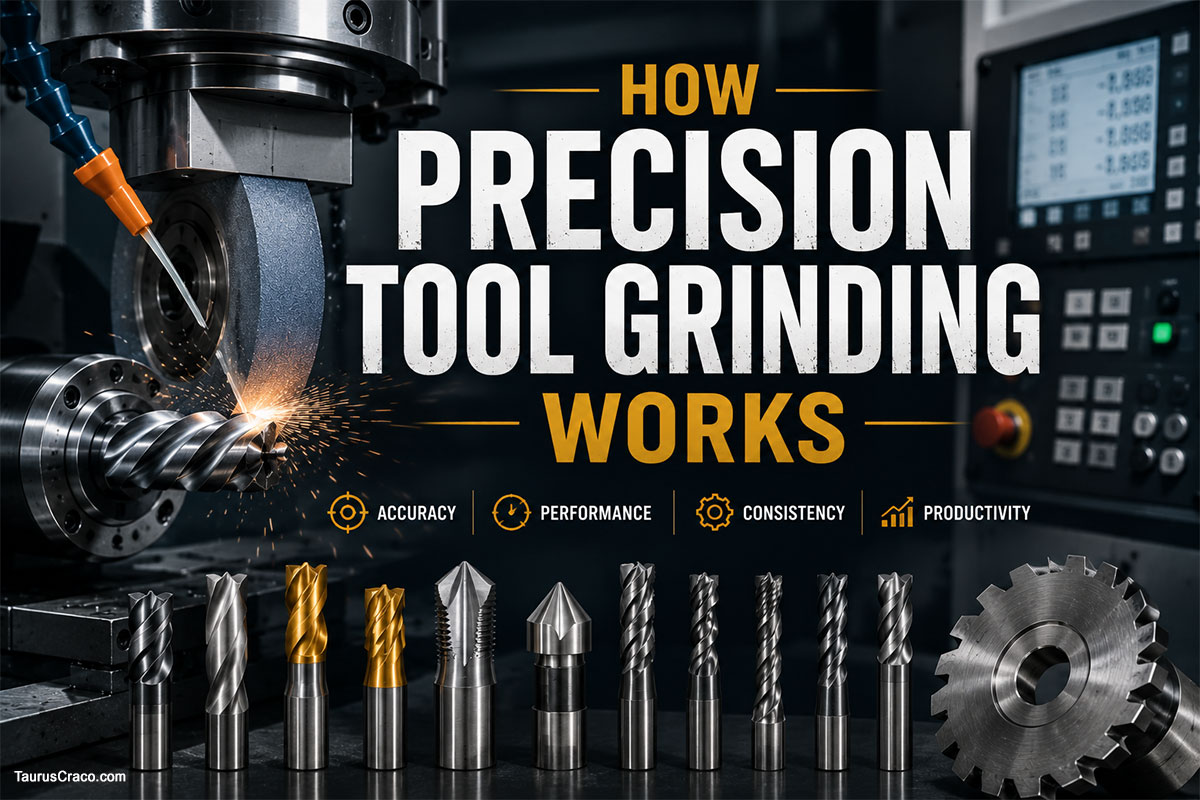
Precision tool grinding improves CNC performance by restoring cutting tools to accurate geometries, sharper cutting edges, and consistent dimensions.
When drills, router bits, end mills, inserts, and other cutting tools become worn, the machine must work harder to complete each cut.
That can lead to poor surface finishes, dimensional inaccuracies, excessive heat, longer cycle times, increased vibration, and premature spindle or toolholder wear.
Professional tool grinding helps return cutting tools to usable condition while maintaining the angles, clearances, edge preparation, and tolerances required for reliable CNC machining.
Quick Answer
Precision tool grinding can improve CNC performance by:
✓ Restoring sharp cutting edges
✓ Improving dimensional accuracy
✓ Reducing cutting resistance
✓ Producing cleaner surface finishes
✓ Decreasing heat generation
✓ Reducing vibration and chatter
✓ Extending tool service life
✓ Supporting more consistent cycle times
✓ Lowering tooling replacement costs
✓ Reducing the risk of tool-related production interruptions
Tool grinding is especially valuable for businesses that use expensive carbide tooling, custom cutters, high-volume CNC production, or applications where part quality must remain consistent.
Precision Tool Grinding Overview
| CNC Performance Area | Effect of Worn Tooling |
Improvement From Precision Grinding |
Cutting accuracy |
Dimensions may drift |
Tool geometry is restored |
Surface finish |
Roughness, tearing, or marks |
Sharper edges create cleaner cuts |
Cycle time |
Slower feeds may be required |
Efficient cutting conditions can be restored |
Heat control |
Friction and heat increase |
Reduced cutting resistance |
Machine load |
Spindle load may rise |
Tools cut more efficiently |
Vibration |
Chatter may become more common |
Balanced, accurate tools improve stability |
Tool costs |
Worn tools are discarded |
Suitable tools may be sharpened and reused |
Production consistency |
Results vary between parts |
Repeatable tool geometry supports consistency |
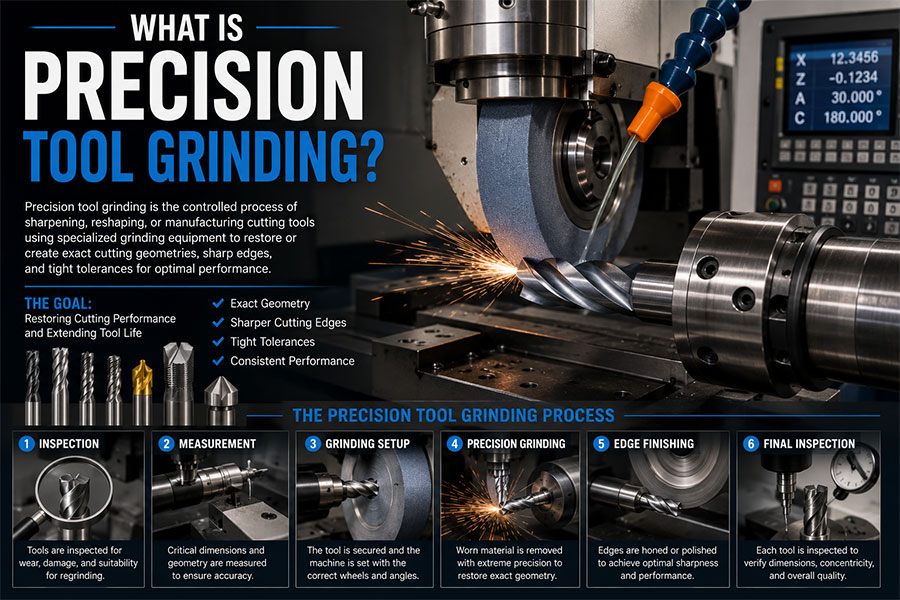
What Is Precision Tool Grinding?
Precision tool grinding is the controlled sharpening, reshaping, or manufacturing of cutting tools using specialized grinding equipment.
The process removes a very small amount of material from the tool to restore or create the required cutting geometry.
Tools that may be sharpened or ground include:
- End mills
- Drills
- Router bits
- Reamers
- Countersinks
- Profile cutters
- Saw blades
- Insert tooling
- Boring tools
- Form tools
- Carbide cutters
- High-speed steel tools
- Custom cutting tools
The grinding process may restore the original manufacturer geometry or modify the tool for a specific application.
Precision is essential.
A cutting edge that appears sharp to the eye may still have incorrect clearance angles, unequal flute geometry, poor concentricity, or an unsuitable edge preparation.
These small differences can significantly affect CNC machine performance.
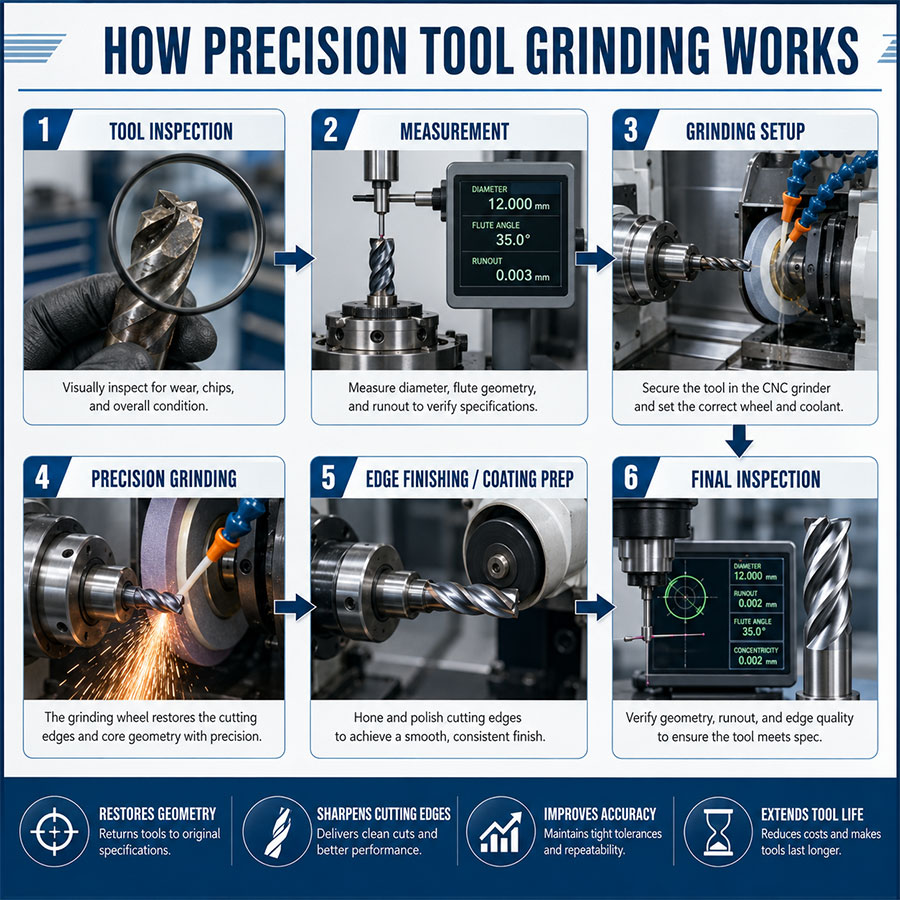
How Precision Tool Grinding Works
Professional tool grinding normally follows a structured process.
1. Tool Inspection
The tool is inspected for wear, chips, cracks, heat damage, and excessive material loss.
Not every tool should be reground.
Tools with severe structural damage may need to be replaced.
2. Tool Measurement
The grinder measures the tool diameter, flute length, cutting angles, relief, runout, and other relevant dimensions.
This helps determine how much material must be removed.
3. Grinding Setup
The tool is secured in a precision grinding machine.
The correct grinding wheel, speed, coolant, and machine program are selected according to the tool material and geometry.
4. Cutting Geometry Is Restored
The grinding machine removes worn material and recreates the required cutting edges, flutes, clearances, and profiles.
Advanced CNC tool grinders can reproduce complex geometries with high repeatability.
5. Edge Preparation and Finishing
Depending on the application, the cutting edge may be honed, polished, or prepared to achieve the desired strength and cutting behaviour.
6. Final Inspection
The finished tool is checked for dimensions, concentricity, edge quality, profile accuracy, and visible defects.
Some tools may also be recoated after grinding.
Why Sharp Tooling Matters in CNC Machining
A CNC machine follows programmed coordinates and toolpaths.
However, the machine can only produce accurate parts when the cutting tool performs as expected.
A worn cutting tool changes the relationship between the program and the actual cut.
For example:
- A worn end mill may cut undersized or oversized features.
- A dull drill may wander or produce rough holes.
- A damaged router bit may tear material instead of cutting cleanly.
- An uneven tool may create vibration or inconsistent surface marks.
- A chipped cutting edge may leave visible defects on every component.
The machine may still complete the program, but the finished part may not meet the required tolerance or quality standard.
This is why tooling condition must be considered alongside the machine itself when evaluating CNC machinery performance.
Precision Grinding Improves Cutting Accuracy
Tool geometry directly affects the dimensions of the finished component.
If a cutter has excessive wear, uneven edges, or incorrect diameter, the CNC machine may not remove the intended amount of material.
Precision grinding restores the tool to a known geometry.
This can improve:
✓ Hole diameter consistency
✓ Slot width accuracy
✓ Profile dimensions
✓ Edge alignment
✓ Surface flatness
✓ Repeatability between production runs
The CNC program may be accurate, but inaccurate tooling can still produce inaccurate parts.
For tight-tolerance work, tool condition should be measured and managed as part of the complete quality-control process.
Precision Tool Grinding Improves Surface Finish
A sharp cutting tool shears material cleanly.
A dull tool tends to rub, compress, tear, or overheat the workpiece.
This can create:
- Rough surfaces
- Burn marks
- Burrs
- Torn fibres in wood-based materials
- Poor edge quality
- Visible tool marks
- Additional sanding or finishing work
- Rejected components
Restoring the cutting edge can reduce these defects.
Better surface finishes may also decrease the need for secondary processing, which helps reduce labour and production time.
This is valuable in both metalworking and industrial woodworking machinery, where finish quality can directly affect assembly, coating, and customer acceptance.
Precision Grinding Reduces Heat
Dull tools create additional friction.
As cutting resistance increases, more energy is converted into heat.
Excessive heat can affect:
- Tool hardness
- Tool coatings
- Workpiece dimensions
- Surface appearance
- Coolant performance
- Spindle load
- Toolholder condition
In metalworking, heat may accelerate cutting-edge wear or affect the workpiece surface.
In woodworking, overheated tooling can create burn marks, resin buildup, and poor edge quality.
A properly sharpened tool removes material more efficiently and can help keep cutting temperatures under control.
Tool Grinding Can Reduce Machine Load
Worn cutting tools require greater force to cut.
That additional resistance may increase the load on:
- Spindles
- Motors
- Toolholders
- Bearings
- Drives
- Workholding systems
Higher machine load does not always indicate a machine problem.
It may be caused by dull, damaged, or incorrectly ground tooling.
Restoring the cutting geometry can reduce resistance and help the machine operate closer to its intended cutting conditions.
Monitoring spindle-load data can help identify gradual tooling wear before part quality declines significantly.
Precision Grinding Helps Control Vibration and Chatter
Chatter is a repeated vibration that occurs between the cutting tool, workpiece, machine, or toolholder.
It can leave visible marks and reduce dimensional accuracy.
Tool-related causes of vibration may include:
- Unequal cutting edges
- Poor tool balance
- Excessive runout
- Chipped flutes
- Incorrect relief angles
- Uneven material removal
- Toolholder contamination
- Improperly sharpened tools
Precision grinding helps ensure that each cutting edge has the correct geometry and removes material evenly.
This does not solve every chatter problem, but it can remove tooling inconsistency as a major source of vibration.
New Tools vs Reground Tools
| Factor | New Cutting Tool |
Professionally Reground Tool |
Purchase cost |
Higher |
Usually lower than replacement |
Geometry |
Original factory geometry |
Restored or application-specific geometry |
Availability |
Depends on supplier stock |
Depends on grinding turnaround |
Tool life |
Full new-tool life |
Depends on remaining tool material |
Customization |
Standard unless specially ordered |
Geometry may be modified |
Sustainability |
Requires new raw material |
Reuses an existing tool |
Best use |
New applications or damaged tools |
Suitable worn tools with recoverable geometry |
A reground tool will not always provide the same remaining service life as a brand-new tool because some material has already been removed.
However, professional grinding can allow many high-quality tools to complete multiple useful service cycles.
Which Tools Are Worth Regrinding?
Tool grinding is most practical when the value of restoring the tool exceeds the cost and risk of replacing it.
Good candidates often include:
✓ Solid-carbide end mills
✓ Large-diameter drills
✓ Custom profile cutters
✓ Expensive router bits
✓ Precision reamers
✓ Specialty form tools
✓ High-quality saw blades
✓ Production tools used in large quantities
✓ Tools with long replacement lead times
Low-cost disposable tools may not justify the grinding expense.
Tools with cracks, severe chips, excessive heat damage, or insufficient remaining material may also need to be replaced.
Tool Regrinding Decision Table
| Tool Condition | Recommended Action |
Normal edge wear |
Regrinding may be economical |
Minor edge chipping |
Inspect and regrind if recoverable |
Severe flute damage |
Replace or evaluate professionally |
Heat discoloration |
Inspect for loss of material integrity |
Cracked carbide |
Replace |
Excessive diameter loss |
Replace if specifications cannot be maintained |
Custom tool with long lead time |
Regrinding may be especially valuable |
Low-cost disposable cutter |
Replacement may be more economical |
Precision Grinding and Tool Coatings
Many carbide cutting tools use coatings to improve wear resistance, heat control, lubricity, or material compatibility.
Grinding removes the coating from the sharpened surfaces.
Depending on the application, the tool may be:
- Used after grinding without recoating
- Recoated with the original coating
- Recoated with a different coating
- Polished or edge-prepared before coating
Recoating can help restore some of the performance characteristics of the original tool.
However, the complete process must preserve the tool’s dimensions and edge geometry.
The decision to recoat depends on the workpiece material, production volume, tool value, and expected service life.
How Tool Grinding Supports Lower Production Costs
Cutting-tool costs can become significant in a high-volume CNC operation.
Precision regrinding may reduce costs by extending the usable life of suitable tools.
Potential savings can come from:
- Purchasing fewer replacement tools
- Reducing emergency tooling orders
- Decreasing part rejection
- Reducing secondary finishing
- Avoiding unnecessary machine downtime
- Maintaining more consistent cycle times
- Reducing excess spindle load
- Improving inventory planning
The savings should be measured carefully.
A cheap grinding service that produces inconsistent geometry can cost more through poor parts, downtime, and shortened tool life.
Tooling Performance Comparison
| Performance Measure | Worn Tool |
Properly Reground Tool |
Cutting resistance |
High |
Lower |
Surface quality |
Inconsistent |
More consistent |
Heat generation |
Higher |
Reduced |
Dimensional accuracy |
May drift |
Improved |
Vibration risk |
Higher |
Lower when properly balanced |
Spindle load |
Increased |
Closer to normal |
Tool reliability |
Unpredictable |
More predictable |
Part rejection risk |
Higher |
Reduced |
How to Choose a Precision Tool Grinding Provider
A qualified grinding provider should be able to explain how tools are inspected, ground, measured, and approved.
Important factors include:
CNC Grinding Capability
Advanced CNC grinding equipment can reproduce complex tool geometries with greater consistency.
Inspection Equipment
The provider should verify dimensions, profiles, edge condition, concentricity, and other critical characteristics.
Experience With the Tool Type
Grinding a saw blade is different from grinding a carbide end mill or custom profile cutter.
The provider should understand the specific application.
Repeatability
Tools returned in the same batch should perform consistently.
Variation between tools can create unpredictable CNC results.
Recoating Options
For coated tools, determine whether recoating is available and whether it is appropriate for the application.
Turnaround Time
Tooling should be returned quickly enough to support production requirements.
A shop may need backup tools while other tools are being serviced.
Traceability
Production environments may benefit from tool identification, service records, and documented dimensions.
Signs That CNC Tools Need Grinding
Cutting tools may need sharpening when operators notice:
✓ Increasing spindle load
✓ Reduced feed rates
✓ Poor surface finishes
✓ Burr formation
✓ Burn marks
✓ Dimensional drift
✓ Excessive vibration
✓ Chipped cutting edges
✓ Increased cutting noise
✓ Higher coolant or cutting temperatures
✓ More frequent part rejection
✓ Longer production cycles
Tools should ideally be serviced before severe damage occurs.
Grinding a moderately worn tool is usually easier and more economical than rebuilding a heavily damaged cutting edge.
Precision Tool Grinding and Preventive Maintenance
Tool management should be included in the shop’s broader maintenance program.
A practical system may include:
- Tool inspection schedules
- Tool-life tracking
- Spindle-load monitoring
- Tool-change documentation
- Storage procedures
- Cleaning standards
- Regrinding limits
- Minimum acceptable dimensions
- Coating records
- Supplier performance reviews
Tooling maintenance works alongside regular machine maintenance.
A well-maintained CNC machine using damaged tools will still produce poor results.
Likewise, a sharp tool installed in a poorly maintained machine may not perform correctly.
The best results come from managing both the machine and the cutting system using a consistent machinery maintenance checklist.
Final Thoughts
Precision tool grinding improves CNC performance by restoring the cutting geometry that allows a machine to operate accurately and efficiently.
Sharp, properly ground tools can reduce cutting resistance, heat, spindle load, vibration, and surface defects.
They can also improve dimensional accuracy, production consistency, and tool inventory costs.
However, successful regrinding depends on accurate inspection, controlled grinding, suitable equipment, and knowledge of the tool’s application.
Not every worn tool should be reground.
Businesses should evaluate the tool’s value, condition, remaining dimensions, coating, production role, and replacement cost before deciding.
Taurus Craco helps industrial businesses evaluate tooling, machinery, maintenance, and production solutions that support reliable CNC performance and long-term operating efficiency.
Frequently Asked Questions
What is precision tool grinding?
Precision tool grinding is the controlled sharpening, reshaping, or manufacturing of cutting tools using specialized grinding equipment. It restores cutting edges, relief angles, flutes, profiles, and other geometries required for accurate machining.
Can CNC cutting tools be sharpened more than once?
Many high-quality carbide and high-speed steel tools can be sharpened several times. The number of regrinding cycles depends on the tool design, wear level, remaining dimensions, damage, and application requirements.
Does regrinding a tool change its diameter?
Regrinding removes a small amount of material, so the tool diameter or other dimensions may change. The CNC program or tool-offset data may need to be updated to reflect the reground tool’s measured size.
Are reground tools as good as new tools?
Professionally reground tools can provide strong and consistent performance when the geometry is restored correctly and enough tool material remains. Performance depends on the tool condition, grinding quality, coating, and application.
When should a CNC cutting tool be replaced instead of reground?
A tool should usually be replaced when it has cracks, severe carbide damage, excessive heat damage, insufficient remaining material, unacceptable diameter loss, or a low replacement cost that makes regrinding uneconomical.