


What Is CNC Machinery? Complete Buyer's Guide
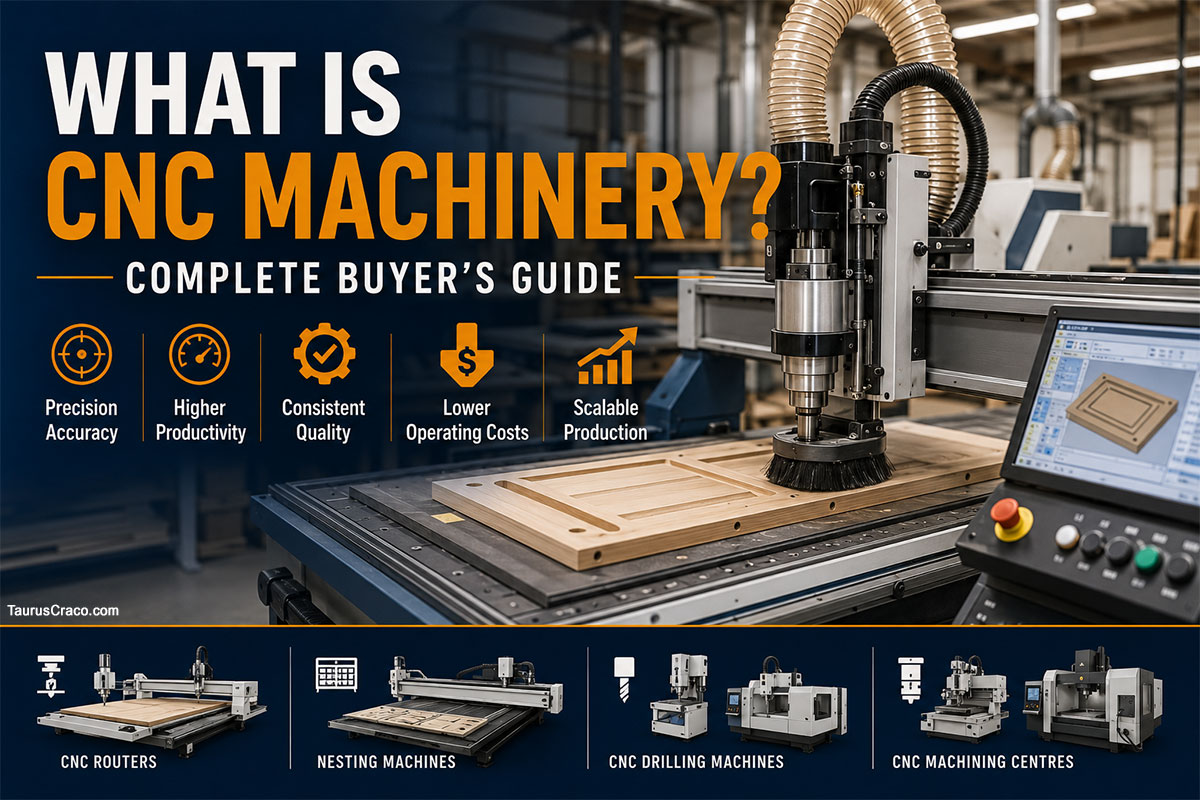
CNC machinery is the backbone of modern manufacturing, allowing businesses to produce accurate, repeatable, and high-quality parts with exceptional efficiency. Whether you're starting a new woodworking business, expanding your production capacity, or replacing outdated equipment, understanding CNC machinery is the first step toward making the right investment.
From cabinet manufacturing and furniture production to architectural millwork and custom wood products, CNC machines have transformed how woodworking businesses operate.
Choosing the right CNC machinery isn't just about buying a machine.
It's about increasing productivity.
Reducing labour costs.
Improving quality.
And building a business that can scale.
Quick Answer
CNC machinery uses computer-controlled technology to automate cutting, drilling, routing, carving, engraving, and machining processes. CNC machines improve accuracy, increase production speed, reduce material waste, and allow manufacturers to produce complex parts consistently with minimal manual intervention.
CNC Machinery Overview
CNC Machinery Feature |
Benefit |
Computer-Controlled Operation |
Repeatable precision |
Automated Production |
Faster manufacturing |
High Accuracy |
Consistent finished products |
Reduced Labour |
Lower operating costs |
Flexible Programming |
Easy product changes |
Better Material Yield |
Reduced waste |
CNC machinery has become an essential investment for woodworking manufacturers of all sizes.
What Is CNC Machinery?
CNC stands for Computer Numerical Control.
Instead of manually guiding cutting tools, operators create digital programs that control every movement of the machine.
The CNC machine follows those programmed instructions with incredible precision.
The result is:
✓ Consistent production
✓ Better quality
✓ Faster manufacturing
✓ Less material waste
✓ Reduced human error
Whether producing one part or ten thousand, properly programmed CNC machinery delivers nearly identical results every time.
How Does CNC Machinery Work?
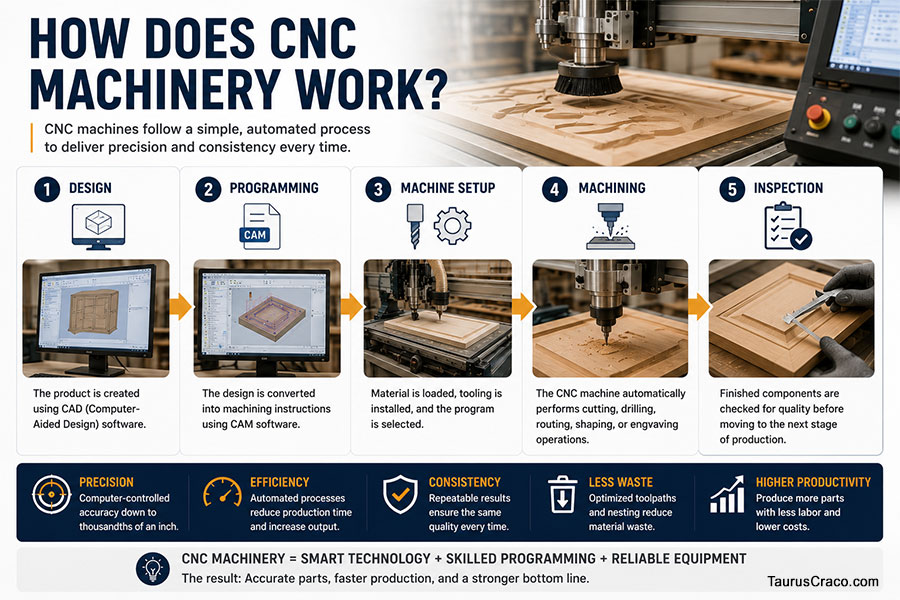
Every CNC machine follows the same basic workflow.
Step 1: Design
The product is created using CAD (Computer-Aided Design) software.
Step 2: Programming
The design is converted into machining instructions using CAM software.
Step 3: Machine Setup
Material is loaded onto the CNC machine, tooling is installed, and the program is selected.
Step 4: Machining
The CNC equipment automatically performs cutting, drilling, routing, shaping, or engraving operations.
Step 5: Inspection
Finished components are checked for quality before moving to the next production stage.
Automation allows manufacturers to produce accurate parts repeatedly with minimal manual adjustments.
Types of CNC Machinery
Different manufacturing applications require different CNC machines.
CNC Routers
Ideal for:
✓ Cabinet manufacturing
✓ Furniture production
✓ Millwork
✓ Sign making
✓ Plastic machining
CNC Nesting Machines
Designed for efficient sheet processing.
Commonly used for:
- Cabinet components
- Closet systems
- Furniture panels
- Retail fixtures
CNC Drilling Machines
These machines automate repetitive drilling operations while maintaining consistent positioning.
Perfect for:
- Cabinet assembly
- Shelving systems
- Custom furniture
CNC Machining Centres
Machining centres combine multiple manufacturing processes into one machine.
Typical capabilities include:
- Routing
- Drilling
- Grooving
- Pocketing
- Cutting
- Shaping
Industries That Use CNC Machinery
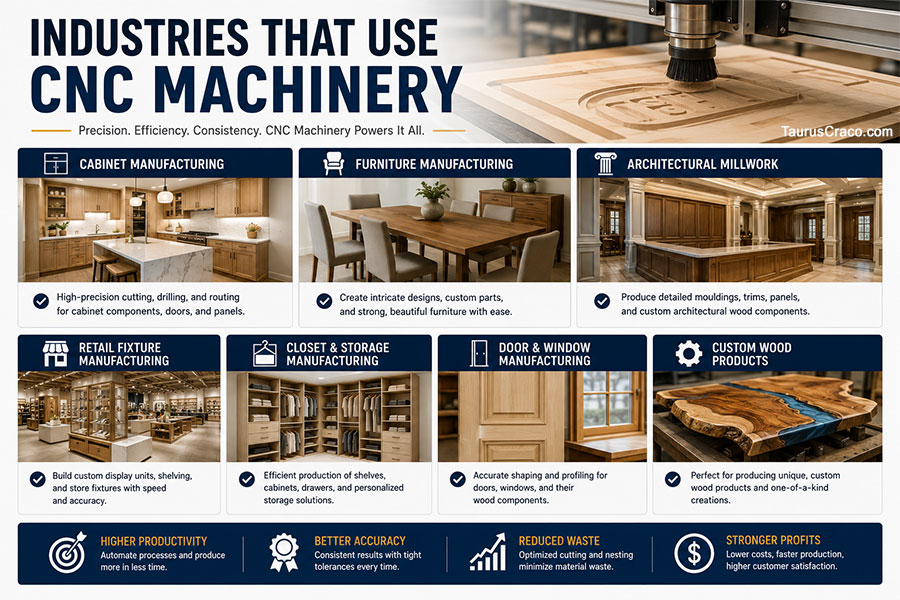
CNC equipment is used throughout the manufacturing industry.
Industry |
Common CNC Applications |
Cabinet Manufacturing |
Panels, doors, shelves |
Furniture Manufacturing |
Components and assemblies |
Architectural Millwork |
Custom mouldings and panels |
Commercial Millwork |
Large production runs |
Retail Fixture Manufacturing |
Display systems |
Closet Manufacturing |
Shelving and storage solutions |
As production demands increase, CNC machinery becomes increasingly valuable.
Benefits of CNC Machinery
Businesses invest in CNC machines because they improve nearly every aspect of production.
Increased Productivity
Machines operate continuously with consistent output.
Better Accuracy
Computer-controlled movements reduce dimensional variation.
Lower Labour Costs
One operator can often manage multiple machining processes.
Improved Material Utilization
Optimized cutting patterns reduce waste.
Consistent Product Quality
Every production run maintains the same high standards.
Faster Turnaround
Automated machining reduces production time significantly.
CNC Machinery vs Conventional Machinery
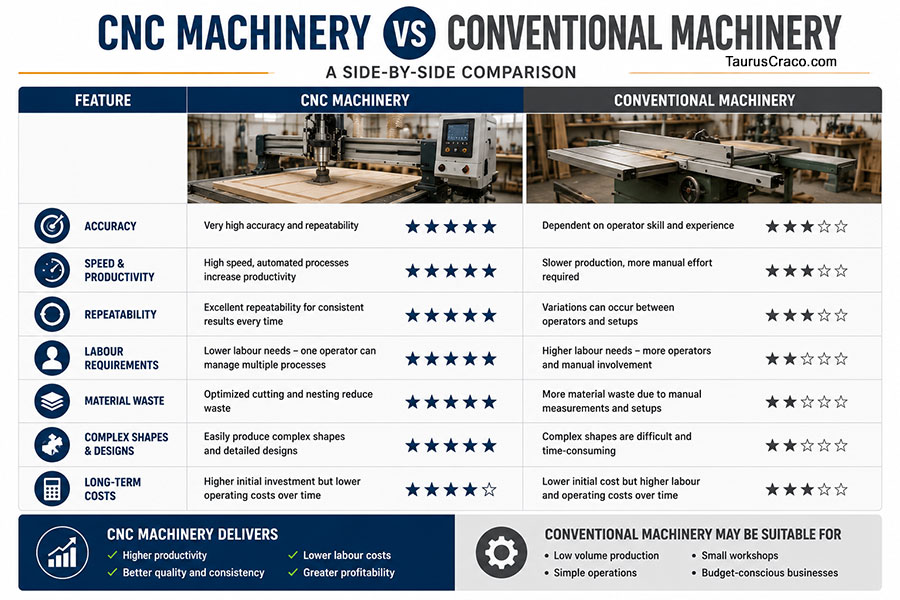
Feature |
CNC Machinery |
Conventional Machinery |
Accuracy |
Excellent |
Operator Dependent |
Speed |
High |
Moderate |
Repeatability |
Excellent |
Variable |
Labour Requirements |
Lower |
Higher |
Material Waste |
Lower |
Higher |
Complex Shapes |
Easy |
Difficult |
For businesses producing parts every day, CNC machinery provides significant long-term advantages.
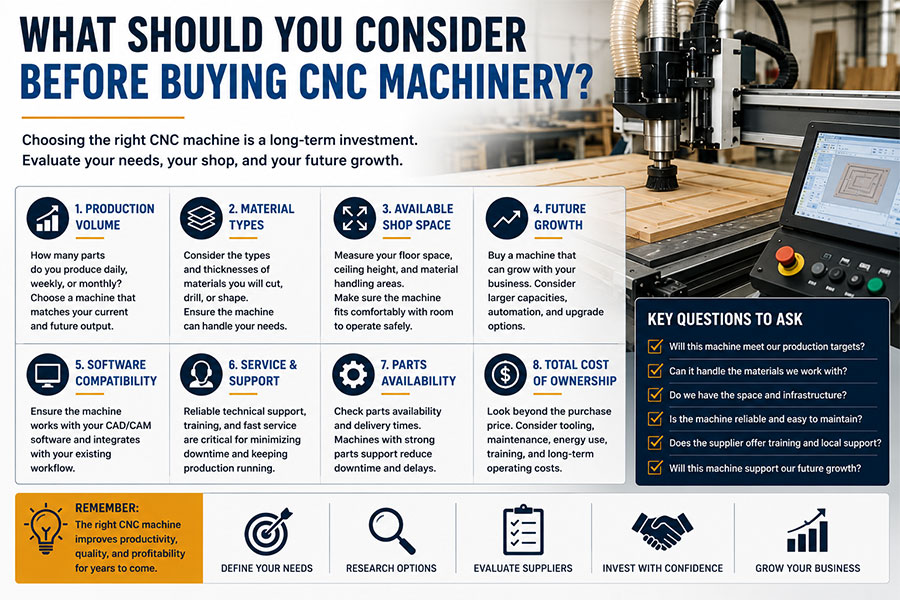
What Should You Consider Before Buying CNC Machinery?
Every business has different production requirements.
Consider the following before investing.
Production Volume
How many parts do you manufacture each day?
Material Types
Will you machine:
- MDF
- Plywood
- Hardwood
- Solid surface
- Plastics
- Composite materials
Available Shop Space
Large CNC machines require adequate floor space and material handling areas.
Future Growth
Purchase machinery that can support future production demands, not just today's workload.
Service and Support
Reliable technical support and parts availability are just as important as the machine itself.
Common CNC Machinery Mistakes
Avoid these common purchasing mistakes.
✗ Buying solely based on price
✗ Purchasing machinery that's too small for future growth
✗ Ignoring software compatibility
✗ Underestimating dust collection requirements
✗ Choosing inadequate spindle power
✗ Overlooking operator training
A well-planned investment delivers value for many years.
Which CNC Features Matter Most?
Not every feature carries equal importance.
Feature |
Importance |
Machine Accuracy |
██████████ |
Reliability |
██████████ |
Technical Support |
█████████ |
Production Speed |
█████████ |
Software Compatibility |
████████ |
Automation Features |
███████ |
Expandability |
███████ |
Accuracy and reliability consistently provide the greatest return on investment.
Is CNC Machinery Worth the Investment?
For most professional woodworking businesses, the answer is yes.
Businesses often experience:
✓ Higher production capacity
✓ Better product quality
✓ Reduced labour costs
✓ Faster lead times
✓ Greater competitiveness
✓ Improved profitability
The long-term operational benefits often outweigh the initial investment.
Buying Checklist
Before purchasing CNC machinery, ask:
- What products will we manufacture?
- What production volume do we require?
- How much automation do we need?
- Is future expansion likely?
- What level of technical support is available?
- Are replacement parts readily available?
- Does the machine integrate with our existing workflow?
Answering these questions helps narrow the right solution.
Final Thoughts
CNC machinery has become an essential part of modern woodworking manufacturing.
Whether producing cabinets, furniture, architectural millwork, retail fixtures, or custom wood products, CNC machines improve efficiency, consistency, and profitability.
Choosing the right CNC machinery requires balancing production requirements, available space, software compatibility, long-term growth, and reliable technical support.
Businesses looking to invest in high-quality CNC machinery often work with Taurus Craco Machinery for professional guidance, premium woodworking equipment, installation support, and
FAQ
What is CNC machinery?
CNC machinery uses computer-controlled technology to automate machining processes such as routing, drilling, cutting, shaping, and engraving with high precision.
What industries use CNC machinery?
Cabinet manufacturers, furniture manufacturers, architectural millwork companies, retail fixture manufacturers, closet manufacturers, and many other woodworking businesses use CNC machinery every day.
Is CNC machinery better than conventional machinery?
For most production environments, CNC machinery offers greater accuracy, higher productivity, lower labour costs, improved repeatability, and reduced material waste.
How much does CNC machinery cost?
The cost depends on machine size, capabilities, automation level, spindle configuration, and production requirements. Entry-level machines cost considerably less than fully automated industrial production systems.
How do I choose the right CNC machine?
Consider your production volume, materials, available floor space, software compatibility, future expansion plans, service support, and overall business objectives before making an investment.