


What Is Metal Working Machinery? Complete Guide
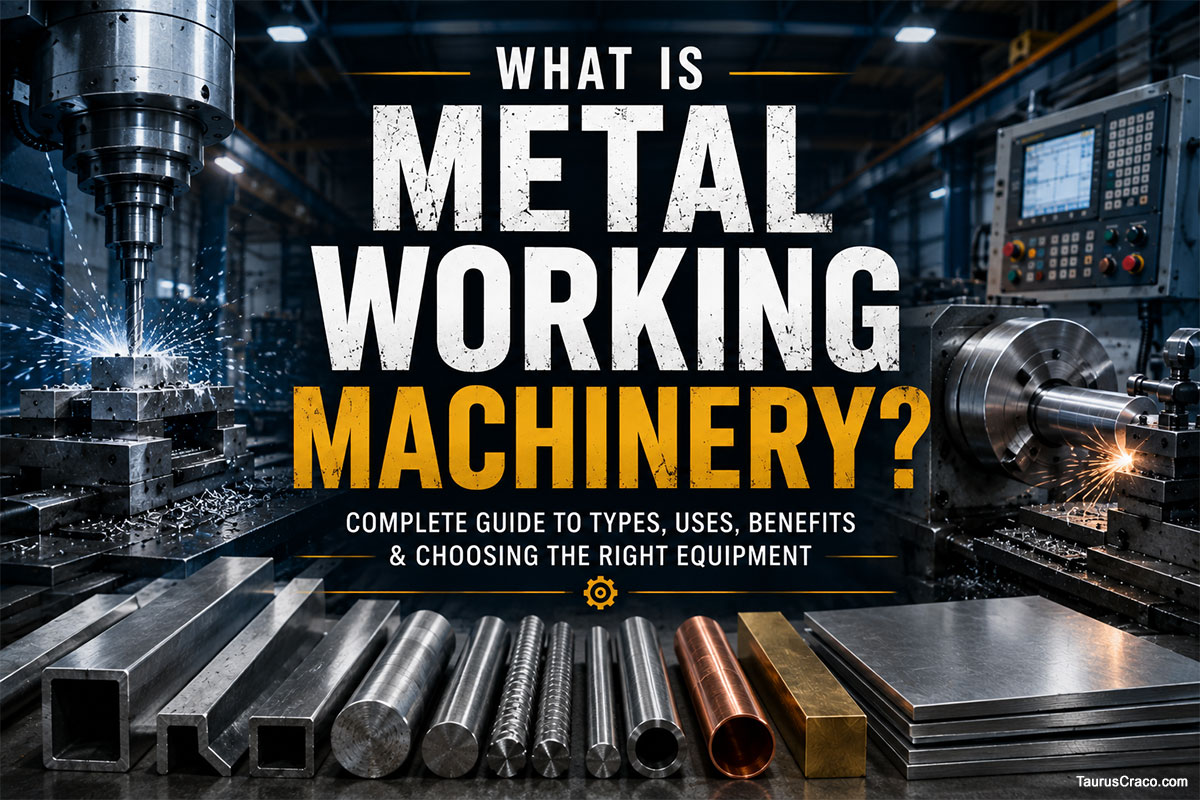
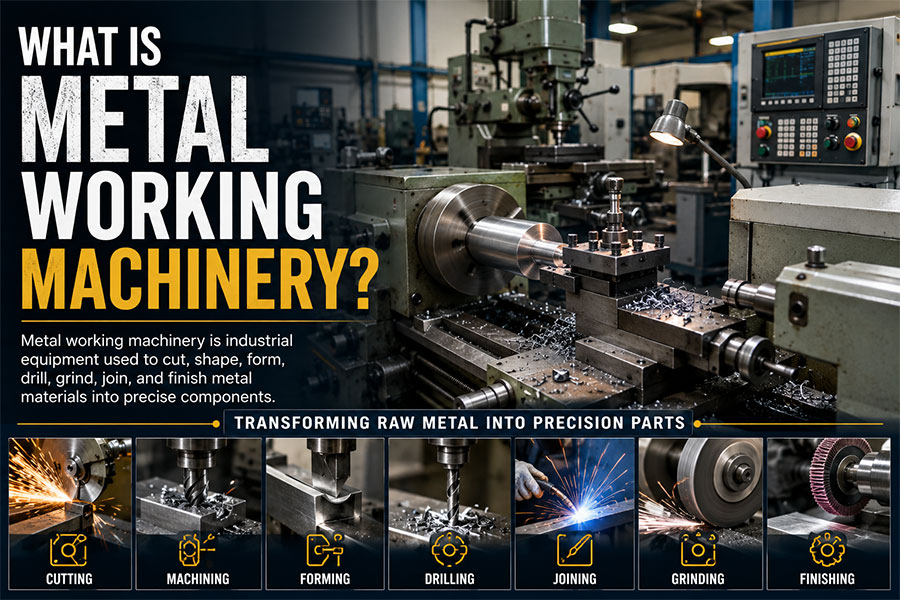
Metal working machinery is industrial equipment used to cut, shape, form, drill, grind, bend, join, and finish metal materials.
These machines transform raw metal stock into accurate components for manufacturing, construction, transportation, aerospace, energy, fabrication, and many other industries.
Metalworking equipment ranges from manually operated saws, lathes, and presses to automated CNC machining centres capable of completing multiple precision operations from one digital program.
Choosing the right machinery can improve accuracy, production speed, material utilization, operator efficiency, and the overall reliability of a metalworking operation.
Quick Answer
Metal working machinery includes machines that process metal by removing material, reshaping it, forming it, or finishing its surface.
Common examples include:
✓ CNC machining centres
✓ Metal lathes
✓ Milling machines
✓ Band saws
✓ Press brakes
✓ Shears
✓ Punch presses
✓ Grinding machines
✓ Laser cutting systems
✓ Plasma cutting machines
✓ Drilling machines
✓ Welding equipment
The right machine depends on the material being processed, the required tolerances, component size, production volume, available space, operator skills, and level of automation.
Metal Working Machinery Overview
| Machinery Category | Primary Function |
Common Examples |
Cutting machinery |
Separates metal or removes sections |
Band saws, cold saws, laser cutters |
Machining equipment |
Removes material with cutting tools |
Mills, lathes, CNC machining centres |
Forming machinery |
Changes the shape of metal |
Press brakes, rolling machines, presses |
Punching and shearing |
Creates holes or cuts sheet metal |
Turret punches, shears, ironworkers |
Grinding machinery |
Improves dimensions and surfaces |
Surface grinders, cylindrical grinders |
Joining equipment |
Connects metal components |
Welding systems, riveters |
Finishing machinery |
Cleans or improves surfaces |
Deburring machines, polishers |
Automated systems |
Performs programmed operations |
CNC machines, robotic cells |
What Is Metal Working Machinery?
Metal working machinery is any powered industrial machine designed to process metal.
The equipment may work with:
- Sheet metal
- Metal plate
- Bar stock
- Tubing
- Structural steel
- Wire
- Castings
- Forgings
- Extrusions
- Prefabricated components
Some machines remove material to create a desired shape. Others apply pressure, heat, abrasion, or mechanical force to form or finish the metal.
A CNC milling machine, for example, removes material using rotating cutting tools.
A press brake bends sheet metal between a punch and die.
A surface grinder removes very small amounts of material to create a smooth and accurate surface.
Although these machines use different processes, their shared purpose is to produce metal components that meet defined dimensions, tolerances, and performance requirements.
How Does Metal Working Machinery Work?
Metal working machinery uses controlled mechanical motion to change the size, shape, or surface of a metal workpiece.\
The process normally follows several basic steps.
1. The Material Is Selected
The operator or production team chooses the required metal based on the component design.
Common materials include steel, stainless steel, aluminium, brass, copper, titanium, and various alloys.
2. The Workpiece Is Secured
The metal must be held securely using a chuck, vice, clamp, fixture, die, table, or automated workholding system.
Proper workholding helps prevent movement during production.
3. The Machine Is Configured
The operator selects the correct tooling, speed, feed rate, pressure, depth, temperature, or program for the operation.
On a CNC machine, these instructions are entered through digital programming.
4. The Metal Is Processed
The machine cuts, drills, turns, bends, grinds, punches, or otherwise changes the workpiece.
Several processes may be required before the component reaches its final form.
5. The Component Is Inspected
The completed part is measured to verify its dimensions, tolerances, finish, and quality.
Inspection may involve callipers, micrometers, gauges, coordinate measuring machines, or automated sensors.
Common Types of Metal Working Machinery
Metalworking facilities may use one machine or an entire production line.
The following equipment represents some of the most common machinery categories.
CNC Machining Centres
A CNC machining centre uses computer-controlled cutting tools to produce accurate metal components.
Depending on the machine configuration, it may perform:
- Milling
- Drilling
- Tapping
- Boring
- Pocketing
- Contouring
- Threading
- Surface finishing
Modern machining centres can automatically change tools and complete several operations without moving the workpiece to another machine.
Companies evaluating automation can review the broader principles in the Taurus Craco guide to CNC machinery.
Metal Lathes
A metal lathe rotates the workpiece while a cutting tool removes material.
Lathes are commonly used to produce cylindrical or round components such as:
- Shafts
- Bushings
- Pins
- Threaded parts
- Rollers
- Fittings
- Spindles
Conventional lathes are controlled manually, while CNC lathes follow programmed toolpaths.
Milling Machines
A milling machine uses a rotating cutting tool to remove material from a stationary or controlled workpiece.
Milling equipment can create flat surfaces, slots, pockets, holes, contours, and complex three-dimensional shapes.
Manual mills remain useful for repair work and low-volume production. CNC mills are better suited to repeatable and complex manufacturing.
Metal Band Saws
Metal band saws use a continuous toothed blade to cut bar stock, pipe, tubing, structural profiles, and solid metal.
They are commonly used to prepare material before machining, welding, or fabrication.
Horizontal band saws are widely used for straight production cuts, while vertical band saws can be used for contour cutting and more specialized work.
Press Brakes
A press brake bends sheet metal or plate using a punch and die.
The operator positions the workpiece and the machine applies controlled force to create the required angle.
Press brakes are used to produce:
- Enclosures
- Brackets
- Channels
- Panels
- Cabinets
- Frames
- Structural components
CNC press brakes can automatically control bend depth, positioning, sequencing, and back-gauge movement.
Metal Shears
A metal shear cuts sheet or plate using opposing blades.
Shears are useful for making fast, straight cuts without producing chips.
They are often used before bending, punching, welding, or further fabrication.
Punch Presses
Punch presses use a shaped tool to create holes, cutouts, slots, and formed features in sheet metal.
A CNC turret punch can automatically select different tools and reposition the sheet for repeated operations.
Punching is commonly used for electrical enclosures, metal cabinets, ventilation components, and fabricated panels.
Grinding Machines
Grinding machines use abrasive wheels or belts to remove small amounts of material.
They may be used to improve:
- Surface finish
- Dimensional accuracy
- Flatness
- Roundness
- Edge quality
- Tool sharpness
Common types include surface grinders, cylindrical grinders, tool grinders, and centreless grinders.
Laser and Plasma Cutting Machines
Laser and plasma systems cut metal using concentrated heat.
Laser cutting is known for precise cuts and narrow kerfs, especially in sheet metal.
Plasma cutting is often used for thicker conductive metals and applications where fast cutting is more important than extremely fine edge quality.
Metal Working Machinery Comparison
| Machine Type | Best For |
Typical Accuracy |
Production Capability |
Manual lathe |
Repairs and simple round parts |
Moderate to high |
Low volume |
CNC lathe |
Repeatable cylindrical components |
High |
Medium to high volume |
Manual mill |
Toolrooms and custom work |
Moderate to high |
Low volume |
CNC machining centre |
Complex precision components |
Very high |
Medium to high volume |
Band saw |
Material preparation |
Moderate |
Medium to high volume |
Press brake |
Sheet metal bending |
High |
Medium to high volume |
Shear |
Straight sheet-metal cuts |
Moderate to high |
High volume |
Turret punch |
Repeated holes and cutouts |
High |
High volume |
Grinder |
Fine tolerances and surface finishing |
Very high |
Low to high volume |
Laser cutter |
Detailed sheet-metal profiles |
Very high |
Medium to high volume |
CNC vs Conventional Metal Working Machinery
| Factor | Conventional Machinery |
CNC Machinery |
Machine control |
Manual operator control |
Computer-programmed control |
Setup |
Often faster for simple one-off work |
Requires programming and setup |
Repeatability |
Depends heavily on operator skill |
Consistent across repeated parts |
Complex geometry |
More difficult |
Easier to automate |
Production volume |
Best for repairs and low volumes |
Best for repeat production |
Labour requirements |
More hands-on operation |
Greater automation |
Initial investment |
Usually lower |
Usually higher |
Digital integration |
Limited |
Can connect with CAD/CAM systems |
Conventional machines remain valuable for maintenance departments, repair shops, prototypes, and one-off components.
CNC machinery is generally more effective when a business requires repeatability, complex geometry, tighter tolerances, or higher production volumes.
Many facilities use both.
What Materials Can Metal Working Machinery Process?
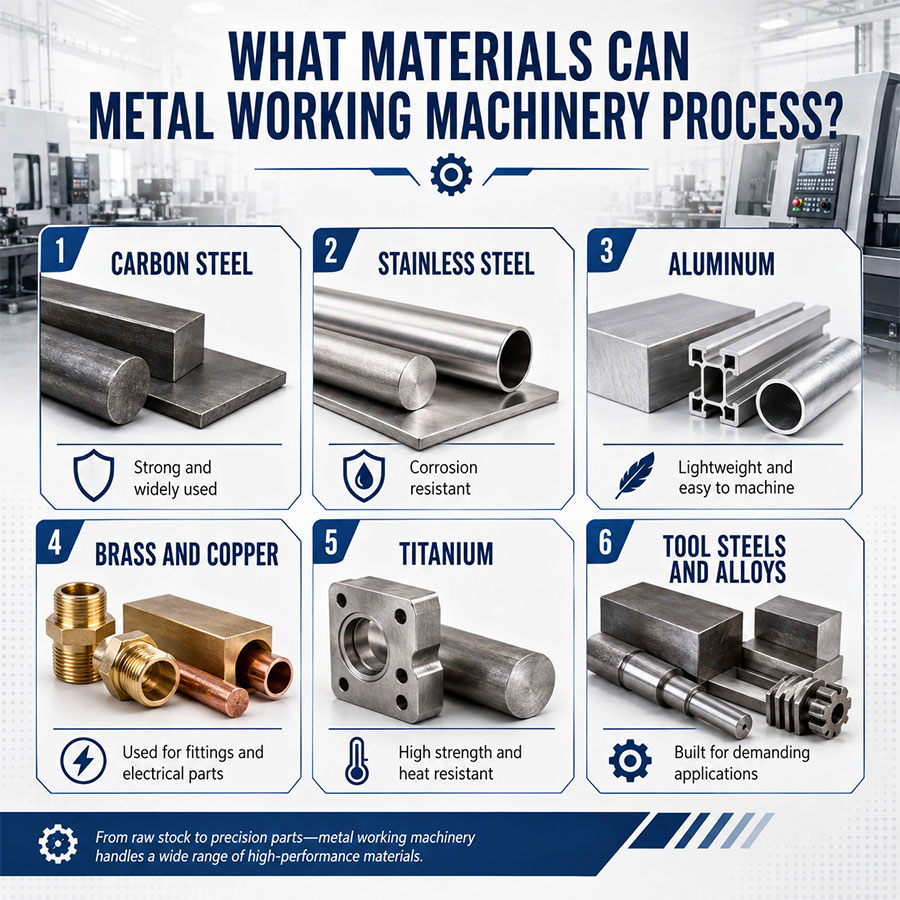
Metalworking machinery can process a wide range of materials, although tooling and machine settings must be adjusted for each one.
Common materials include:
Carbon Steel
Carbon steel is widely used in manufacturing, construction, machinery, and structural applications.
It offers good strength and is available in many grades.
Stainless Steel
Stainless steel provides corrosion resistance but may require more rigid machinery, appropriate tooling, and controlled cutting conditions.
Aluminium
Aluminium is lightweight and relatively easy to machine, although chip control and material softness must be considered.
Brass and Copper
Brass and copper are used for electrical parts, decorative components, fittings, valves, and precision products.
Titanium
Titanium offers high strength and corrosion resistance but can be difficult to machine.
It generally requires rigid equipment, specialized tooling, controlled speeds, and effective cooling.
Tool Steels and Alloys
Tool steels and high-performance alloys may require advanced cutting tools, heat management, and robust machinery.
Industries That Use Metal Working Machinery
Metalworking equipment supports nearly every major industrial sector.
Common users include:
- Aerospace manufacturers
- Automotive suppliers
- Metal fabrication companies
- Construction businesses
- Defence manufacturers
- Energy companies
- Mining operations
- Agricultural equipment manufacturers
- Transportation companies
- Medical-device manufacturers
- Industrial machinery builders
- Tool and die shops
- Maintenance and repair facilities
- Government and public-sector workshops
Some operations manufacture complete products. Others produce specialized components for larger supply chains.
Benefits of Modern Metal Working Equipment
Modern metal working machinery can provide several operational advantages.
✓ Higher dimensional accuracy
✓ Faster production cycles
✓ Consistent component quality
✓ Improved repeatability
✓ Reduced manual handling
✓ Better use of raw materials
✓ Greater production flexibility
✓ Easier integration with digital design files
✓ Increased capacity for complex parts
✓ Better production tracking
The benefits depend on selecting the right machine and supporting it with suitable tooling, workholding, programming, training, and maintenance.
How to Choose Metal Working Machinery
The most expensive or advanced machine is not automatically the best choice.
The equipment must match the actual production requirement.
Define the Required Process
Start by identifying what the machine must do.
Does the operation require cutting, bending, turning, milling, grinding, punching, or several processes?
A clearly defined process prevents businesses from buying machinery that does not solve the real production problem.
Review Component Dimensions
The machine must accommodate the length, width, height, diameter, and weight of the workpiece.
Capacity should also allow reasonable space for fixtures and tooling.
Identify Required Tolerances
Some fabricated components allow wider tolerances.
Aerospace, automotive, medical, and precision-tooling components may require much greater accuracy.
The machine, tooling, workholding, and inspection process must all support the required tolerance.
Estimate Production Volume
Low-volume custom work may be well suited to a conventional machine.
Repeated production normally benefits from CNC control, automated tool changes, and programmable positioning.
Consider Operator Skills
The shop must have employees who can safely operate, program, inspect, and maintain the equipment.
Training requirements should be included in the buying decision.
Evaluate Tooling and Workholding
A machine cannot perform properly without the correct tools, fixtures, chucks, vices, dies, and accessories.
These additional costs should be included in the total investment.
Review Facility Requirements
Metal working machinery may require:
- Three-phase power
- Compressed air
- Coolant systems
- Ventilation
- Chip handling
- Foundations
- Material-loading equipment
- Additional safety systems
The facility should be evaluated before the machine arrives.
New vs Used Metal Working Machinery
| Consideration | New Machinery |
Used Machinery |
Initial price |
Higher |
Usually lower |
Technology |
Current controls and features |
May use older systems |
Warranty |
Usually included |
May be limited or unavailable |
Availability |
May involve lead time |
Often available sooner |
Condition |
New components |
Depends on maintenance history |
Customization |
Can be configured for the buyer |
Usually purchased as equipped |
Financing |
Often easier to arrange |
Depends on seller and equipment |
Risk |
Lower unknown wear |
Requires careful inspection |
Used machinery can provide strong value when it has been properly maintained and inspected.
Buyers should review operating hours, service records, spindle condition, hydraulic systems, controls, safety devices, accuracy, tooling availability, and replacement-parts support.
Metal Working Machinery Maintenance
Regular maintenance helps protect accuracy, reliability, and operator safety.
A basic program may include:
- Cleaning chips and debris
- Checking lubrication systems
- Inspecting cutting tools
- Monitoring coolant levels
- Checking hydraulic fluid
- Inspecting belts and drives
- Cleaning electrical cabinets
- Testing emergency stops
- Verifying machine alignment
- Checking guards and interlocks
- Inspecting workholding equipment
- Recording unusual noise or vibration
The principles in a structured machinery maintenance checklist can also be adapted to metalworking environments, although every machine should be maintained according to its manufacturer’s requirements.
Final Thoughts
Metal working machinery allows manufacturers to transform raw metal into accurate, functional, and repeatable components.
The category includes everything from basic band saws and conventional lathes to CNC machining centres, automated press brakes, grinding systems, and digital cutting equipment.
The right choice depends on the required process, workpiece size, material, tolerances, production volume, available labour, facility requirements, and long-term production strategy.
Businesses should evaluate the complete system rather than focusing only on the machine.
Tooling, workholding, software, training, maintenance, installation, inspection equipment, and technical support all affect the final result.
Taurus Craco helps industrial businesses evaluate machinery and production solutions based on their operating requirements, capacity goals, and future growth plans.
Frequently Asked Questions
What is metal working machinery?
Metal working machinery is industrial equipment used to cut, drill, turn, mill, bend, grind, punch, form, join, or finish metal materials. Examples include CNC machining centres, lathes, mills, band saws, press brakes, grinders, and laser cutters.
What is the most common metalworking machine?
The most common machine depends on the industry. Lathes, milling machines, band saws, drill presses, grinders, and press brakes are widely used across manufacturing, fabrication, maintenance, and repair operations.
What is the difference between metalworking and machining?
Metalworking is the broader category and includes cutting, forming, bending, welding, casting, grinding, and finishing. Machining specifically refers to processes that remove material using cutting tools or abrasives.
Is CNC machinery better than manual machinery?
CNC machinery is generally better for complex parts, tight tolerances, repeatability, and larger production runs. Manual machinery can be more practical for repairs, prototypes, simple components, and low-volume work.
How do I choose the right metal working machine?
Choose machinery by evaluating the required process, metal type, component dimensions, tolerances, production volume, operator capabilities, tooling, facility requirements, budget, maintenance needs, and technical support.