


How Dust Collectors Improve Woodworking Shops

Woodworking dust collectors improve air quality, production efficiency, equipment reliability, and workplace cleanliness by removing sawdust and fine airborne particles directly from woodworking machines.
Every cut, routing operation, sanding pass, and machining cycle produces dust.
Without an effective dust collection system, that material spreads throughout the shop, enters machinery, settles on finished components, and creates unnecessary safety and maintenance problems.
A properly designed woodworking dust collection system captures dust close to the source and moves it into a controlled collection unit before it can circulate through the facility.
Quick Answer
A dust collector improves a woodworking shop by:
✓ Capturing dust directly from production machinery
✓ Reducing airborne wood particles
✓ Keeping work areas and finished products cleaner
✓ Preventing dust from accumulating inside equipment
✓ Supporting safer working conditions
✓ Reducing cleanup and maintenance requirements
✓ Improving machine reliability and production efficiency
Dust collectors are commonly connected to CNC routers, panel saws, edgebanders, sanders, moulders, planers, and other industrial woodworking machinery.
Woodworking Dust Collection Overview
| Area of the Shop | Problem Without Dust Collection |
Improvement With Dust Collection |
Air quality |
Fine dust remains airborne |
Dust is captured near the machine |
Machinery |
Dust enters motors and components |
Equipment remains cleaner |
Production |
Operators stop for frequent cleanup |
Workflows experience fewer interruptions |
Product quality |
Dust settles on parts and finishes |
Components remain cleaner |
Safety |
Dust accumulates on floors and surfaces |
Housekeeping becomes easier |
Maintenance |
Filters, vents, and moving parts clog |
Maintenance demands may decrease |
Facility cleanliness |
Sawdust spreads throughout the shop |
Dust is contained in a designated system |

What Is a Woodworking Dust Collector?
A woodworking dust collector is an industrial air-handling system designed to capture sawdust, wood chips, and fine particles produced by woodworking equipment.
The system normally includes:
- Dust hoods or machine ports
- Ductwork
- A fan or blower
- Filters or separator systems
- Collection bins, bags, drums, or containers
- Controls and monitoring components
The dust collector creates airflow that pulls debris away from the cutting or sanding area.
Larger chips and particles are transported through the ductwork into the collection system. Fine particles are separated from the air using filters, cyclones, or a combination of technologies.
Cleaned air may then be discharged outside or returned to the facility when the system has been designed for that purpose.
How Does a Dust Collection System Work?
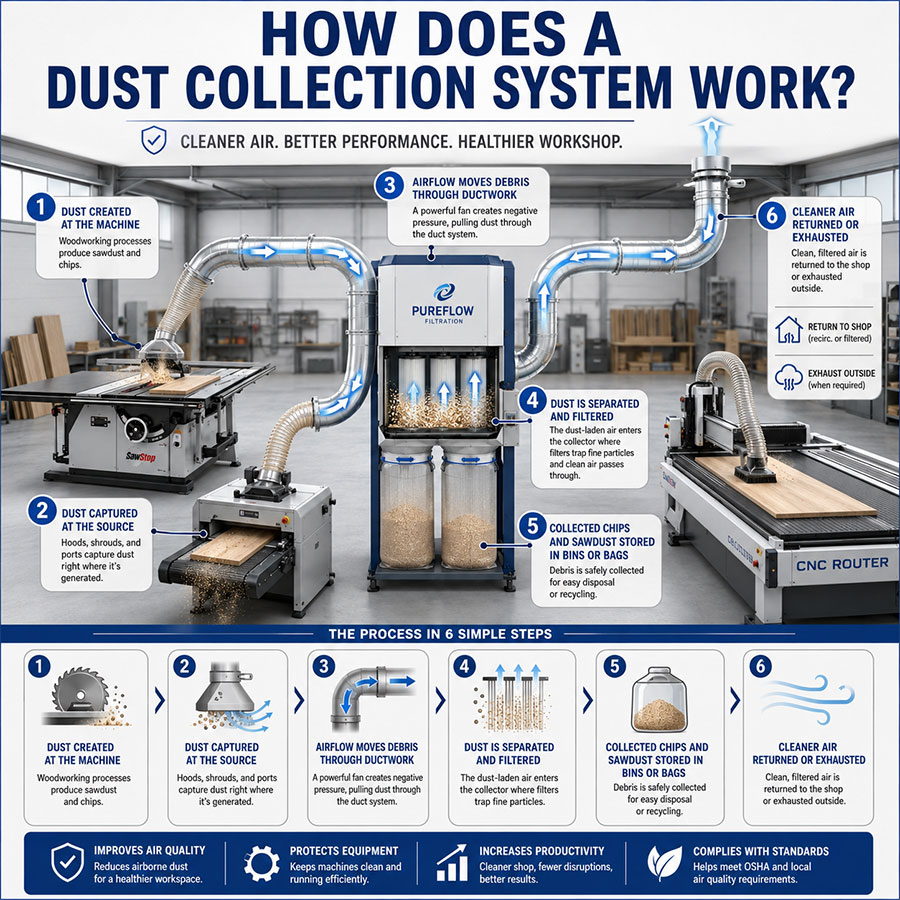
An industrial dust collection system follows a straightforward process.
1. Dust Is Produced
Wood dust is created when material is cut, routed, drilled, shaped, sanded, or planed.
Different machines produce different volumes and particle sizes.
A panel saw may generate larger chips and sawdust, while a wide-belt sander can create a significant amount of fine airborne dust.
2. Dust Is Captured at the Machine
Dust hoods and extraction ports are positioned near the point where debris is produced.
Capturing dust close to the source is more effective than trying to remove it after it has already spread through the shop.
The design of the hood, port, and machine enclosure can have a major effect on collection performance.
3. Airflow Moves Dust Through Ductwork
A fan creates negative pressure inside the duct system.
This airflow pulls dust away from the machinery and moves it through a network of pipes.
The ductwork must provide sufficient airflow while minimizing unnecessary bends, restrictions, and pressure loss.
4. Dust Is Separated From the Air
The collected material enters a separator or filtration unit.
Depending on the system, separation may involve:
- Cartridge filters
- Bag filters
- Cyclone separators
- Multiple-stage filtration
- Spark detection or isolation components
- Automatic filter-cleaning systems
Larger particles may be separated before the air reaches the primary filters.
5. Dust Is Stored for Disposal
Collected material is deposited into bins, bags, barrels, or larger storage containers.
The dust can then be removed from the facility according to the shop’s disposal procedures.
How Dust Collectors Improve Air Quality
Fine wood dust can remain suspended in the air long after a machine has stopped operating.
Sweeping the floor or using compressed air can make the problem worse by sending settled particles back into the workspace.
A dust collector reduces this exposure by capturing material before it spreads.
Better air quality can contribute to:
✓ A more comfortable working environment
✓ Less visible airborne dust
✓ Cleaner workstations
✓ Reduced dust settling on tools and inventory
✓ Easier overall facility maintenance
Dust collection should be combined with appropriate ventilation, housekeeping, personal protective equipment, and safe operating procedures.
A dust collector is an important part of the solution, but it does not replace proper shop management.
Dust Collection Helps Protect Woodworking Machinery
Dust does not only affect the air.
It can also enter sensitive machine components.
Wood dust may accumulate around:
- Motors
- Electrical cabinets
- Cooling fans
- Sensors
- Linear guides
- Bearings
- Drive components
- Control panels
- Pneumatic systems
This buildup may interfere with cooling, movement, sensing, or electrical performance.
Machines that remain cleaner are generally easier to inspect and maintain.
An effective dust collection system can support the practices outlined in a regular woodworking machinery maintenance checklist.
It may also help reduce the amount of manual cleaning required around CNC equipment and production machinery.
Dust Collectors Improve Product Quality
Dust can create quality problems even when machinery is operating correctly.
Loose particles may settle on panels before finishing, enter adhesive applications, contaminate coatings, or become trapped between components during assembly.
These problems can contribute to:
- Uneven finishes
- Adhesion issues
- Surface contamination
- Visible particles in coatings
- Additional sanding or refinishing
- Rejected components
- Customer complaints
A cleaner production environment makes it easier to maintain consistent finishing and assembly standards.
This is especially important for cabinet doors, architectural millwork, furniture components, and other products where appearance matters.
Dust Collection Can Increase Productivity
A shop without effective dust extraction may lose production time to cleanup, machine interruptions, and manual dust removal.
Operators may need to repeatedly:
- Sweep around machines
- Vacuum work surfaces
- Clear blocked extraction ports
- Clean sensors or guides
- Remove dust from finished parts
- Stop production to empty small collection bags
A properly sized system helps automate much of the dust-removal process.
This allows operators to concentrate on production rather than constantly managing debris.
The result can be smoother workflows and fewer interruptions.
Common Types of Woodworking Dust Collectors
Different shops require different collection technologies.
Dust Collector Comparison Table
| Dust Collector Type | Best Application |
Main Advantages |
Main Limitations |
Single-stage collector |
Small shops and individual machines |
Simple and economical |
Fine dust reaches the filter |
Two-stage collector |
Small to medium production shops |
Separates larger particles first |
Requires more space |
Cyclone system |
High chip and dust volumes |
Efficient pre-separation |
Higher initial investment |
Cartridge collector |
Fine dust applications |
Large filter area in compact housing |
Filters require proper maintenance |
Baghouse collector |
Large industrial facilities |
Handles high airflow volumes |
Requires significant installation space |
Central dust collection system |
Multiple production machines |
Centralized control and collection |
Requires professional system design |
Portable dust collector |
Temporary or localized use |
Flexible and easy to reposition |
Limited capacity and airflow |
Portable vs Central Dust Collection Systems
| Factor | Portable System |
Central System |
Number of machines |
Usually one machine at a time |
Multiple machines |
Installation |
Minimal |
Requires ductwork and planning |
Mobility |
High |
Permanently installed |
Capacity |
Lower |
Medium to very high |
Automation |
Limited |
Can include automated controls |
Best for |
Small shops or occasional use |
Production facilities |
Future expansion |
Limited |
Can be designed for expansion |
Portable collectors can work well for small shops with a limited number of machines.
Larger facilities usually benefit from a centralized system that connects several machines through engineered ductwork.
Which Woodworking Machines Need Dust Collection?
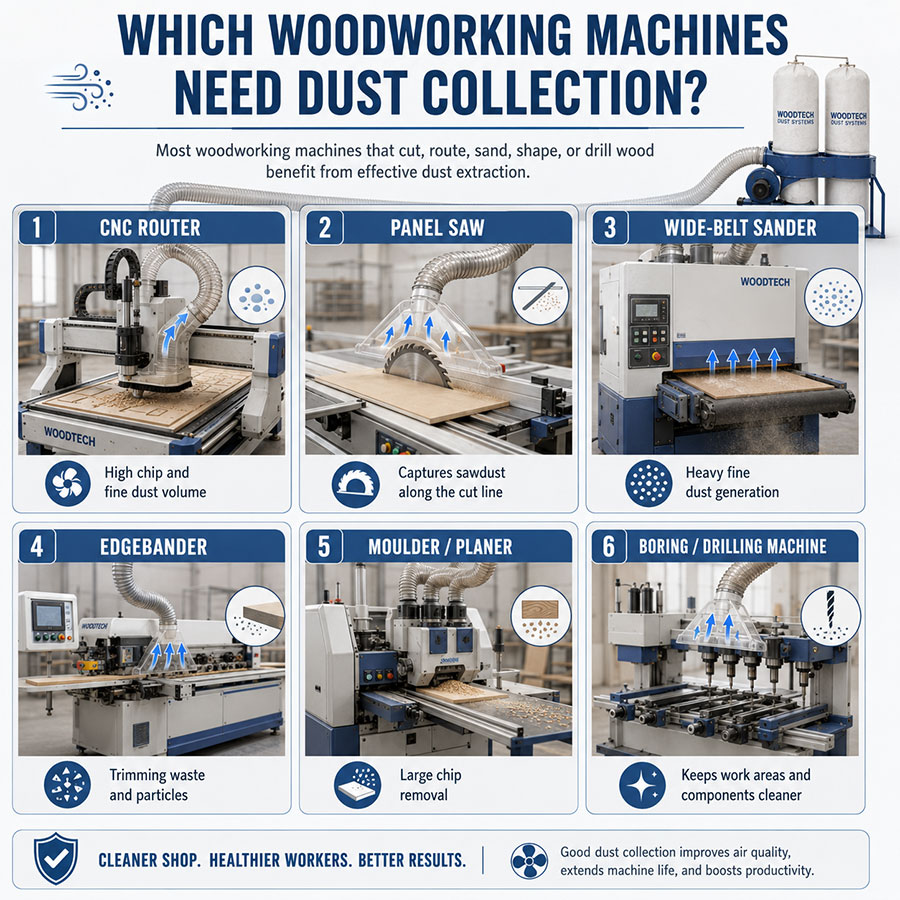
Almost every machine that removes wood material can benefit from dust extraction.
Common examples include:
CNC Routers
CNC routers can produce large amounts of dust and chips while cutting sheet materials.
The extraction system must capture debris around the cutting tool without interfering with machine movement.
Businesses choosing or upgrading this type of equipment should consider dust extraction as part of the complete CNC machinery buying process.
Panel Saws
Panel saws generate dust along the cutting line.
Proper hoods and extraction points help capture material from both above and below the panel.
Edgebanders
Edgebanders can produce trimming waste, fine particles, and chips during edge processing.
Multiple extraction points may be required along the machine.
Sanders
Wide-belt sanders and finishing sanders can create substantial quantities of fine dust.
These machines often require strong, consistent airflow.
Moulders and Planers
Moulders and planers remove large volumes of material quickly.
Their dust systems must handle heavier chips while maintaining sufficient air velocity.
Boring and Drilling Machines
Drilling operations may produce smaller volumes of dust, but extraction helps keep work surfaces and machine components clean.
Industries That Use Woodworking Dust Collectors
Woodworking dust collection systems are used across many manufacturing environments.
Common industries include:
- Cabinet manufacturing
- Furniture production
- Architectural millwork
- Door manufacturing
- Window manufacturing
- Flooring production
- Wood component manufacturing
- Stair and railing production
- Commercial woodworking
- Construction material manufacturing
- School and institutional workshops
The required system capacity depends on the number of machines, production schedule, material type, and volume of dust produced.
Operational Impact of Dust Collection
The following chart provides a practical view of where dust collection can create the greatest operational improvements.
| Operational Area | Potential Impact |
Airborne dust control |
Very high |
Shop cleanliness |
Very high |
Machine cleanliness |
High |
Product finishing quality |
High |
Manual cleanup time |
High |
Equipment cooling |
Moderate to high |
Waste handling |
Moderate to high |
Operator visibility |
Moderate |
Production consistency |
Moderate to high |
The actual impact depends on the system design and the condition of the existing shop.
A poorly designed dust collector may move air without effectively capturing dust at the source.

How to Choose a Woodworking Dust Collector
Selecting a dust collector requires more than choosing a fan with a large airflow number.
The complete system must be matched to the machinery and facility.
Calculate Machine Airflow Requirements
Each machine has specific airflow and duct-size requirements.
The system must provide sufficient airflow when the required machines are operating.
Identify Simultaneous Machine Use
A shop where five machines may run at the same time requires a different system than a shop where only one machine operates at once.
Automatic blast gates and machine controls can help direct airflow where it is needed.
Evaluate Dust and Chip Volume
Heavy chips from planers and moulders may require different handling than fine dust from sanding.
The collector must be selected for the type and volume of material being produced.
Plan the Ductwork Carefully
Long duct runs, sharp bends, undersized pipes, and unnecessary restrictions reduce performance.
The duct layout should be designed to maintain appropriate airflow throughout the system.
Consider Filter Performance
Filters must be suitable for the particle size and application.
The system should also make filter inspection, cleaning, and replacement manageable.
Review Collection Capacity
Bins or containers that are too small will require frequent emptying.
High-production shops may benefit from larger storage systems or automated waste handling.
Plan for Future Machinery
A dust collection system should account for reasonable future expansion.
Adding a CNC router, sander, or second production line later may significantly increase airflow requirements.
Signs a Shop Needs Better Dust Collection
A woodworking shop may need a new or upgraded system when:
✓ Visible dust remains in the air
✓ Dust accumulates quickly around machinery
✓ Operators frequently stop to clean equipment
✓ Extraction ports clog regularly
✓ Finished parts require repeated cleaning
✓ Filters load faster than expected
✓ New machinery has been added
✓ Existing ductwork has been expanded without recalculating airflow
✓ Some machines receive much stronger suction than others
✓ The collector cannot support simultaneous production
These problems may result from an undersized collector, poor duct design, blocked filters, air leaks, improper hood placement, or insufficient system maintenance.
Dust Collector Maintenance Checklist
Dust collectors require regular maintenance to operate effectively.
A basic maintenance program should include:
- Inspecting filters
- Cleaning or replacing loaded filters
- Checking collection bins
- Looking for duct blockages
- Inspecting hoses and connections
- Checking for air leaks
- Testing blast gates
- Verifying fan performance
- Inspecting machine hoods
- Cleaning sensors and controls
- Reviewing system pressure readings
- Documenting recurring performance issues
Maintenance frequency should be based on production volume, material type, collector design, and manufacturer recommendations.
Final Thoughts
Dust collectors improve woodworking shops by controlling debris before it spreads through the facility.
The right system can help protect workers, machinery, finished products, and production schedules.
However, dust collection performance depends on the entire system.
The collector, filters, ductwork, machine hoods, controls, and waste storage must work together.
A large collector connected to poorly designed ductwork may still deliver weak results.
For this reason, woodworking businesses should evaluate dust collection as part of the complete production environment rather than treating it as a separate accessory.
Taurus Craco can help woodworking businesses evaluate industrial machinery, dust collection equipment, and supporting systems for new installations, shop upgrades, and production expansion.
Frequently Asked Questions
What does a woodworking dust collector do?
A woodworking dust collector captures sawdust, chips, and fine airborne particles produced by saws, routers, sanders, edgebanders, moulders, and other machinery. The material is moved through ductwork into a filtration and storage system.
Does every woodworking machine need dust collection?
Most machines that cut, sand, drill, route, plane, or shape wood benefit from dust collection. The required airflow and hood design vary according to the machine and the amount of material it produces.
What size dust collector does a woodworking shop need?
The correct size depends on the machines being connected, their airflow requirements, how many machines operate simultaneously, duct length, material type, and expected production volume. A system should be sized based on the complete installation rather than the collector alone.
What is the difference between a cyclone and a regular dust collector?
A cyclone uses centrifugal force to separate larger chips and particles before the air reaches the primary filter. A regular single-stage collector sends collected material directly to the filter and collection bag or bin.
Can a dust collector improve machine performance?
A dust collector can support machine performance by removing debris from cutting areas and reducing dust accumulation around motors, sensors, guides, cooling systems, and electrical components. It does not replace routine maintenance, but it can help keep equipment cleaner and easier to service.