


Moulder Machine Guide: Spindles, Feed Speed and Tooling
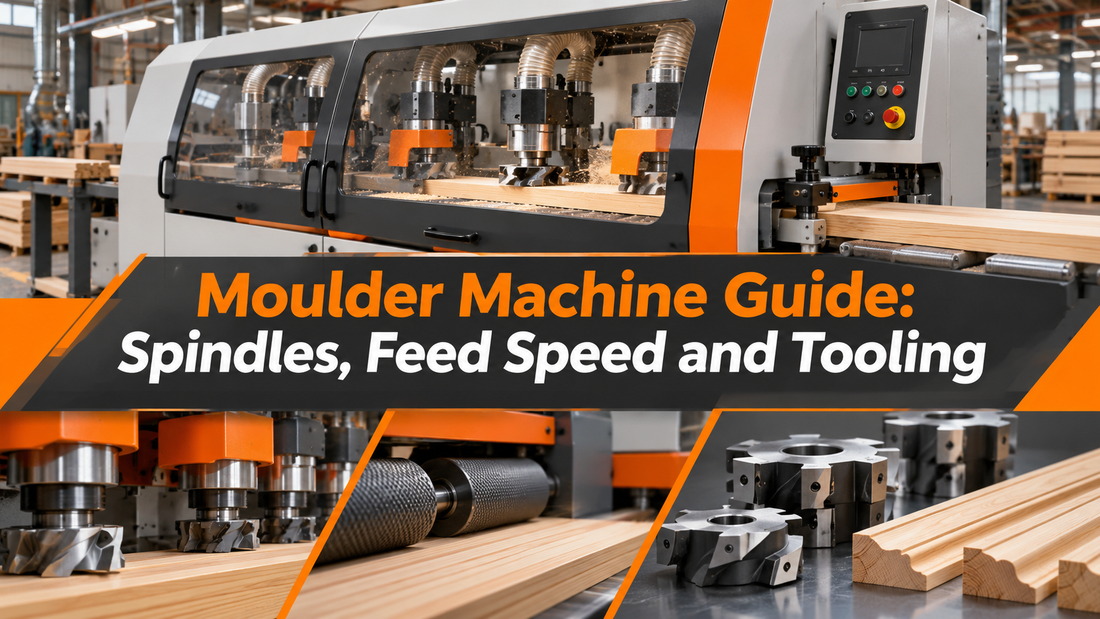
A production moulder can transform rough or dimensioned wood stock into finished mouldings, flooring, trim, door components, window parts, furniture components, and architectural profiles in a controlled continuous process.
But choosing a moulder requires more than comparing the number of spindles.
Spindle arrangement, feed speed, working dimensions, tooling, setup time, horsepower, dust collection, and production volume all determine whether the machine will perform efficiently in a real manufacturing environment.
Taurus Craco supplies woodworking moulders for professional solid-wood production, including multi-spindle BOSS Magnitude systems for higher-output profiling.
This guide explains what to evaluate when choosing a production moulder and how spindle count, feed rate, tooling, stock preparation, profile complexity, and maintenance affect output and finished quality.
Quick Answer: What Should You Look for in a Woodworking Moulder?
Before selecting a moulder, evaluate:
- Maximum stock width and thickness
- Minimum stock dimensions
- Number of spindles
- Spindle arrangement
- Spindle diameter and speed
- Available horsepower
- Maximum feed speed
- Feed-roll configuration
- Tooling diameter and profile requirements
- Setup and changeover method
- Required surface finish
- Dust extraction capacity
- Production volume
- Operator training and maintenance support
The best moulder is the machine that can produce the required profile at a sustainable feed rate while maintaining dimensional accuracy and finish quality.
What Is a Moulder Machine?
A woodworking moulder feeds linear stock through multiple cutter spindles.
Each spindle removes material from a different surface or creates part of the final profile.
Depending on configuration, one pass can:
- Size the workpiece
- Plane the top and bottom
- Machine both side faces
- Create decorative profiles
- Produce tongue-and-groove joints
- Create flooring profiles
- Machine trim and moulding profiles
- Prepare door or window components
This is why moulders are widely used in architectural millwork, flooring, furniture, door, window, and linear wood-product manufacturing.
Taurus Craco's What Is Woodworking Machinery? Complete Guide includes moulders among the key solid-wood production machines used in industrial woodworking.
1. Why Spindle Count Matters
Each spindle gives the machine another opportunity to size or profile a face during the same pass.
A simple moulding profile may require fewer operations.
A more complex flooring or architectural product may need additional heads for:
- Bottom machining
- Right-side machining
- Left-side machining
- Top machining
- Additional profiling
- Fine finishing
More spindles can reduce secondary machining, but they also increase machine size, tooling investment, setup complexity, and dust-extraction demand.
The BOSS Magnitude 6018 6-Spindle Moulder is one current Taurus Craco option for multi-head production.
2. Spindle Arrangement Is More Important Than the Number Alone
Two moulders with the same number of spindles may still perform differently because the heads are arranged differently.
A typical sequence may include:
Bottom → Right → Left → Top → Additional Profile → Finish
The correct sequence depends on:
- Profile geometry
- Which surfaces establish reference dimensions
- Tool diameter
- Required finish
- Stock stability
Before choosing a machine, provide actual profile drawings or samples whenever possible.
The machine should be configured around the work the shop intends to produce.
3. Working Width and Thickness
A moulder has a defined stock envelope.
Record the smallest and largest products the machine must process.
Consider:
- Maximum finished width
- Maximum rough width
- Maximum stock thickness
- Minimum part thickness
- Minimum part length
Do not size the machine only around the finished profile.
Rough stock may enter the machine larger than the final dimension.
4. Feed Speed Determines More Than Throughput
Feed speed affects how quickly material moves past the cutterheads.
Higher feed rates can increase output, but only when:
- Spindle horsepower is sufficient
- Tooling supports the required chip load
- Stock is prepared consistently
- Feed rolls maintain control
- Dust extraction removes chips effectively
- The required surface finish is maintained
A machine's maximum advertised feed speed should not be treated as the feed speed every profile will run successfully.
The sustainable production rate depends on material and tooling.
5. Feed-Roll Control Is Critical
The stock must remain controlled while several cutterheads remove material.
Feed rolls help maintain:
- Consistent movement
- Contact with machine reference surfaces
- Stable part orientation
- Repeatable finished dimensions
Worn, contaminated, or poorly adjusted feed rolls can contribute to slippage, inconsistent feed, surface marking, and dimensional errors.
6. Tooling Determines the Profile
The machine supplies power, feed, and positioning.
The cutterhead creates the actual profile.
Moulder tooling may include:
- Straight cutterheads
- Profile heads
- Insert tooling
- Corrugated-back knife heads
- Jointing-capable tooling systems
- Custom profile knives
Tooling selection affects:
- Surface finish
- Maximum feed speed
- Setup time
- Tool life
- Profile repeatability
- Sharpening strategy
Taurus Craco also provides tooling and profile-grinding services for woodworking operations that require accurate, repeatable cutter profiles.
7. Cutter Diameter and Spindle Speed
Tool diameter and spindle speed work together to determine cutting speed at the knife edge.
Larger tooling can create different cutting conditions from smaller tools.
Always confirm:
- Permitted tool diameter
- Spindle RPM
- Tool bore
- Tool balance
- Manufacturer speed rating
Never assume a cutter that physically fits a spindle is automatically suitable for the intended speed.
8. Horsepower Should Match the Cut
Removing a light profile from softwood requires less power than making a deep profile in dense hardwood at a high feed rate.
Horsepower should be evaluated by spindle and application.
Consider:
- Wood species
- Depth of cut
- Width of cut
- Tool diameter
- Feed rate
- Number of knives
Insufficient power can force the shop to slow feed rates and reduce the capacity it expected from the machine.
9. Stock Preparation Affects Moulder Performance
A moulder performs best when incoming stock is reasonably controlled.
Excessively twisted, bowed, or inconsistent lumber can create feed and dimensional problems.
Many solid-wood production systems therefore prepare stock using jointers, planers, rip saws, or optimizing systems before moulding.
A typical workflow may be:
Rough Lumber → Jointer / Planer → Rip Saw → Moulder → Sanding / Finishing
Better input material helps the moulder produce better output.
10. Moulder vs Shaper
A shaper and moulder can both create profiles, but they serve different production styles.
Shaper
- Highly flexible
- Often operator-fed or power-fed
- Good for custom or lower-volume profiles
- Processes one primary operation at a time
Moulder
- Designed for continuous linear production
- Uses multiple spindles
- Can machine several faces in one pass
- Better suited to repeat production
If the shop produces short runs of many different custom profiles, a shaper may remain useful.
If the business produces repeated mouldings, flooring, trim, door parts, or millwork at higher volume, a moulder can significantly reduce handling and secondary machining.
11. Changeover Time Matters in Short-Run Production
High feed speed receives attention, but setup time can matter more in a shop that changes profiles several times per day.
Evaluate:
- Tool access
- Spindle positioning
- Digital readouts
- Recipe storage
- Feed adjustment
- Pressure and guide adjustment
- Tooling organization
A slower machine with fast, repeatable changeovers may outperform a higher-speed machine that loses substantial production time between jobs.
12. Dust Collection Requirements Increase With Spindle Count
A moulder can remove a large amount of wood in one pass.
Every active cutterhead creates chips that need to be extracted.
Before installing a multi-spindle machine, confirm the shop's industrial dust collection system can support the number and diameter of extraction outlets.
Poor extraction can:
- Allow chips to recirculate
- Reduce finish quality
- Increase internal machine buildup
- Increase maintenance
- Shorten tooling life
Moulder Selection by Application
| Application | Primary Moulder Priorities |
|---|---|
| Architectural moulding | Profile flexibility, finish quality, tooling support |
| Flooring | High feed speed, dimensional control, tongue-and-groove tooling |
| Door components | Repeatable sizing, profile accuracy, surface finish |
| Window components | Precision, repeatable setup, profile complexity |
| Furniture parts | Flexible profile capability and changeover |
| High-volume trim | Feed speed, uptime, tooling life, automation |
How Many Spindles Does Your Shop Need?
Start with the profiles the business plans to produce.
Map each required machining operation to a spindle.
Then consider whether additional heads are justified for:
- Profile complexity
- Finishing cuts
- Future product lines
- Reducing secondary operations
Do not buy spindle count as a status metric.
Buy the configuration that supports actual profiles and production goals.
Tooling Cost Should Be Included in the Machine Budget
A moulder without the correct tooling cannot produce the intended product.
Budget for:
- Initial production profiles
- Backup knives or inserts
- Toolholders and cutterheads
- Sharpening
- Profile grinding
- Setup gauges
- Tool storage
Tooling can be a meaningful part of the total investment, especially when many custom profiles are required.
Common Moulder Buying Mistakes
- Choosing only by spindle count
- Ignoring spindle arrangement
- Buying for maximum feed speed instead of sustainable production speed
- Underestimating tooling cost
- Ignoring changeover time
- Feeding poorly prepared stock into the machine
- Underestimating dust collection
- Failing to plan infeed and outfeed space
- Ignoring feed-roll maintenance
- Buying too little spindle horsepower for deep profiles
Moulder Buying Checklist
Before requesting a quote, document:
- Products being manufactured
- Profile drawings or samples
- Wood species
- Rough and finished stock dimensions
- Required spindle sequence
- Tool diameters
- Target feed rate
- Required surface finish
- Daily production volume
- Typical run length
- Number of profile changes per shift
- Available electrical capacity
- Dust collection capacity
- Infeed and outfeed space
- Tooling and grinding requirements
Maintenance Protects Accuracy and Uptime
A production moulder relies on spindle bearings, feed rolls, tooling, pressure systems, guides, lubrication, and dust extraction.
Routine maintenance should include:
- Tooling inspection
- Feed-roll inspection
- Spindle checks
- Guide and table cleaning
- Lubrication
- Dust-hood inspection
- Drive-system checks
- Calibration
The Woodworking Machinery Maintenance Checklist provides a broader structure for preventative maintenance across industrial woodworking equipment.
When Does a Production Moulder Make Sense?
A moulder becomes increasingly valuable when:
- The same profiles are produced repeatedly
- Multiple faces require machining
- Shaper operations create too much handling
- Labour is spent moving parts between machines
- Profile consistency must improve
- Production volume is increasing
- The shop wants to move from custom machining toward continuous production
Taurus Craco's Best Woodworking Machinery for Manufacturing Shops explains why production machinery should be selected around bottlenecks and repeatable manufacturing requirements rather than simply adding more manual labour.
Final Thoughts
A moulder is a production system, not just a collection of cutterheads.
The machine must control the stock, maintain reference surfaces, power the tooling, remove chips, and reproduce the same profile at the required feed rate.
Start with the product profile.
Then determine stock dimensions, spindle sequence, horsepower, feed speed, tooling, changeover requirements, and dust extraction.
For high-volume moulding, flooring, door, window, trim, and architectural millwork production, the correct multi-spindle machine can replace several separate machining steps with one controlled pass.
Taurus Craco Machinery supplies industrial woodworking moulders, tooling support, profile grinding, training, and service for professional solid-wood manufacturing operations.
Frequently Asked Questions
What is a woodworking moulder used for?
A woodworking moulder machines multiple faces of linear wood stock to create mouldings, flooring, trim, furniture components, door parts, window parts, and architectural profiles in a continuous feed process.
How many spindles should a moulder have?
The correct spindle count depends on the number of surfaces and profile operations required. Map each machining step to the spindle sequence and add capacity only where it reduces secondary operations or supports realistic future products.
What determines moulder feed speed?
Sustainable feed speed depends on wood species, depth and width of cut, cutter diameter, number of knives, spindle horsepower, tooling condition, feed-roll control, dust extraction, and required surface finish.
What is the difference between a moulder and a shaper?
A shaper is flexible and commonly used for individual profiling operations, while a production moulder uses multiple spindles to machine several faces in one continuous pass. Moulders are generally better suited to repeated higher-volume linear production.
Why is tooling so important on a moulder?
The tooling creates the final profile and directly affects finish quality, feed speed, machine load, and repeatability. Tool design, balance, sharpening, profile accuracy, and compatibility with spindle speed are critical to moulder performance.