


Woodworking CNC Machines: Nesting vs Pod and Rail CNC
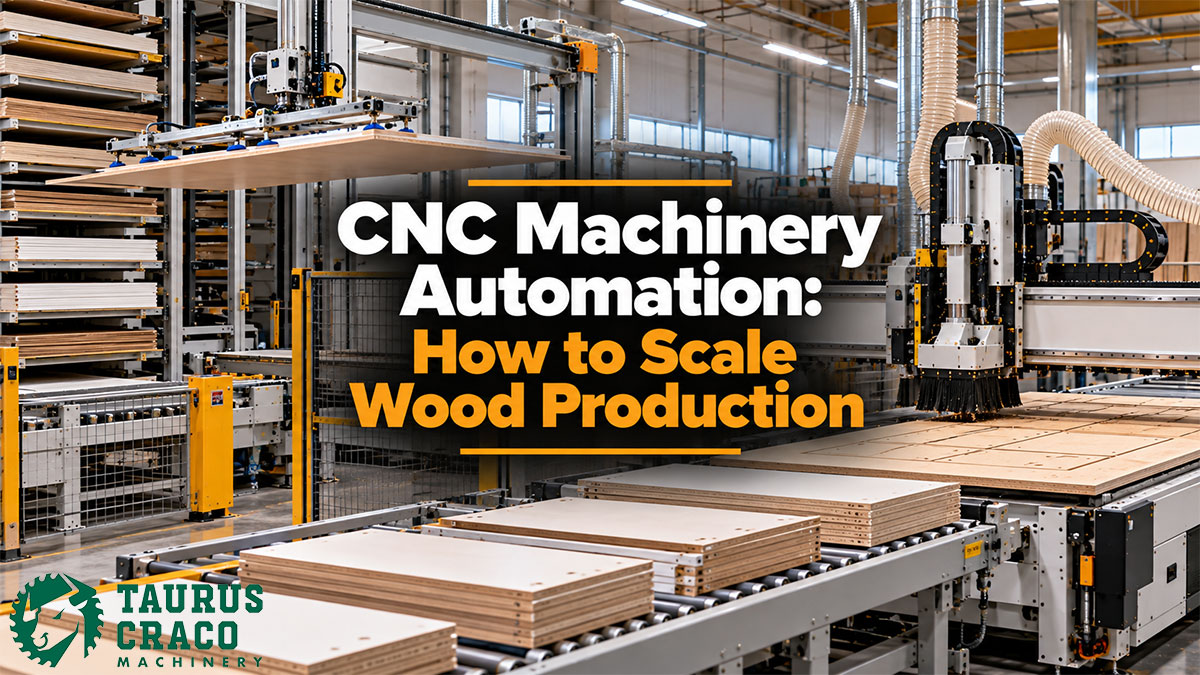
Choosing between nesting and pod-and-rail woodworking CNC machines can determine how efficiently a shop processes panels, cabinet components, furniture parts, doors, architectural millwork, and custom products.
Both CNC configurations automate cutting, routing, drilling, grooving, and machining operations.
But they hold material differently.
They support different production workflows.
And each design performs better for certain types of woodworking.
For a cabinet manufacturer processing full sheets of MDF or plywood, a flat-table nesting CNC may provide the most efficient workflow. For a shop machining individual doors, frames, solid-wood components, or parts requiring edge access, a pod-and-rail CNC may provide greater flexibility.
Taurus Craco supplies both woodworking CNC machines, allowing manufacturers to select CNC machinery around their actual materials, products, production volume, automation requirements, and future growth.
This guide compares nesting CNC machines with pod-and-rail CNC machining centres so you can determine which configuration better matches your woodworking operation.
Quick Answer: Nesting CNC vs Pod and Rail CNC
A nesting CNC uses a large flat worktable, typically with vacuum hold-down, to process sheet goods. Multiple cabinet or furniture components can be arranged digitally across a full sheet and machined during one setup.
A pod-and-rail CNC supports individual components on adjustable vacuum pods mounted to rails. Raising the workpiece above the machine bed provides access around more of the component for routing, drilling, profiling, and edge machining.
| Feature | Nesting CNC | Pod and Rail CNC |
|---|---|---|
| Primary Workholding | Flat vacuum table | Adjustable vacuum pods and rails |
| Best Material Format | Full sheets and panels | Individual components |
| Typical Applications | Cabinets, closets, panel furniture | Doors, frames, furniture, millwork |
| Material Optimization | Excellent for sheet nesting | Focused on individual components |
| Edge Access | More limited during flat-table machining | Greater access around raised parts |
| Batch Panel Production | Excellent | Application dependent |
| Irregular Components | Good with proper hold-down | Often highly flexible |
| Setup Approach | Load full sheet and nest parts | Position individual parts on pods |
What Is a Nesting CNC Machine?
A nesting CNC router uses a large flat work surface to process complete sheets or large panels.
The production software arranges individual components within the available sheet area. This process is called nesting.
The CNC then follows programmed toolpaths to machine those parts from the sheet.
Operations may include:
- Cutting cabinet parts
- Routing component profiles
- Drilling shelf-pin holes
- Machining hardware locations
- Routing dados and grooves
- Creating pockets
- Producing cutouts
- Machining furniture components
Taurus Craco's flat-table nesting CNC machines are designed for woodworking operations that need efficient panel and sheet processing.
How Does CNC Nesting Work?
Nesting begins with digital part information.
The software determines how components can be arranged across a sheet while considering dimensions, spacing, machining requirements, and other production parameters.
The sheet is placed on the CNC table.
Vacuum hold-down helps secure the material.
The machine then cuts and machines the nested components according to the programmed job.
This creates a workflow that can replace several manual operations with one digitally controlled process.
A cabinet side, shelf, stretcher, back, divider, and other components may all be produced from the same sheet according to the production program.
What Shops Benefit Most From Nesting CNC?
Nesting CNC machines are particularly well suited to businesses that process significant volumes of sheet goods.
Common applications include:
- Kitchen cabinet manufacturing
- Closet systems
- Commercial casework
- Office furniture
- Retail fixtures
- Panel furniture
- Custom cabinetry
- Architectural panels
Materials may include MDF, plywood, particleboard, melamine-faced panels, laminated products, and other sheet materials compatible with the CNC and tooling configuration.
Advantages of Nesting CNC Machines
Efficient Sheet Utilization
Nesting software can arrange multiple components across available material, helping manufacturers use sheet area efficiently.
Fewer Manual Setups
Multiple parts can be processed from one sheet rather than being individually measured and positioned for every operation.
Integrated Machining
A nesting CNC can combine cutting, drilling, grooving, routing, and pocketing within a programmed job.
Repeatable Production
Once a job is programmed correctly, the CNC can reproduce component geometry repeatedly with consistent machine positioning.
Strong Cabinet Production Workflow
Nesting works particularly well when panels move directly into edgebanding, drilling, assembly, and other cabinet-manufacturing processes.
C.R. Onsrud Nesting CNC Options
Taurus Craco offers several C.R. Onsrud flat-table CNC configurations for professional manufacturing.
The C.R. Onsrud G Series CNC Router uses a moving-gantry, fixed-table configuration designed for continuous panel and sheet processing.
Another option is the C.R. Onsrud T Series CNC Router, a production-oriented moving-gantry platform for shops that need greater machining capability than an entry-level CNC platform.
The correct model should be selected according to table dimensions, spindle requirements, drilling needs, tooling, material, production volume, automation, and shop layout.
What Is a Pod and Rail CNC Machine?
A pod-and-rail CNC machining centre approaches workholding differently.
Instead of laying an entire sheet across a continuous spoilboard, individual components are positioned on vacuum pods attached to adjustable rails.
The pods support the workpiece above the machine base.
This configuration can provide access around the workpiece and makes pod-and-rail machines valuable for component-based machining.
Taurus Craco lists dedicated pod and rail CNC machines within its woodworking CNC category.
What Can a Pod and Rail CNC Machine Do?
Depending on machine configuration, pod-and-rail CNC machining may include:
- Routing
- Drilling
- Grooving
- Profiling
- Edge machining
- Hardware machining
- Joinery
- Component shaping
Because individual workpieces can be elevated above the support system, pod-and-rail designs can be particularly useful when a component needs machining beyond a simple top-down nesting operation.
What Shops Benefit Most From Pod and Rail CNC?
Pod-and-rail CNC machines can be well suited to woodworking operations producing individual components rather than primarily breaking down full sheets.
Examples include:
- Cabinet doors
- Furniture components
- Solid-wood parts
- Frames
- Architectural millwork
- Curved components
- Door and window components
- Specialty joinery
The flexibility of the workholding system can also help manufacturers process components of different dimensions by repositioning pods and rails for the next job.
Advantages of Pod and Rail CNC Machines
Component Access
Elevating the workpiece can make it easier to machine edges and selected areas that are difficult to reach while a panel lies directly on a flat spoilboard.
Flexible Workholding
Pods can be arranged to support different component geometries within the machine's capacity.
Ideal for Individual Parts
A shop does not need to process a complete sheet simply to machine one component.
Useful for Complex Woodworking
Pod-and-rail machining can fit well into door, furniture, window, frame, and architectural millwork production.
Supports Multiple Operations
Depending on machine configuration, routing, drilling, profiling, and other machining operations can be combined in one CNC cycle.
Nesting CNC vs Pod and Rail CNC: Detailed Comparison
| Buying Factor | Nesting CNC | Pod and Rail CNC |
|---|---|---|
| Full-Sheet Processing | Excellent | Not its primary advantage |
| Cabinet Box Components | Excellent | Good depending on workflow |
| Individual Component Machining | Good | Excellent |
| Doors and Frames | Application dependent | Excellent |
| Sheet Optimization | Excellent | Limited relevance |
| Edge Access | More limited | Strong |
| High-Volume Panel Production | Excellent | Application dependent |
| Mixed Component Sizes | Good | Very flexible |
| Material Handling Focus | Full sheets and nested components | Individual workpieces |
Which CNC Is Better for Cabinet Manufacturing?
For cabinet box production based heavily on sheet goods, nesting CNC is often the natural starting point.
A full sheet can be loaded, multiple cabinet components nested, and cutting plus machining completed according to the production program.
After machining, components can move into processes such as:
CNC Nesting → Edgebanding → Drilling → Assembly
For shops producing cabinet doors, solid-wood frames, curved parts, or components requiring additional edge machining, pod-and-rail technology can become highly valuable.
Some larger manufacturers may therefore use both configurations because they solve different production problems.
Taurus Craco's article on woodworking machinery for cabinet shops explains how CNC machinery fits into the complete cabinet-production environment.
Which CNC Is Better for Furniture Manufacturing?
Furniture manufacturers should look closely at the type of components being produced.
Panel-based furniture can strongly favour nesting.
Furniture made from individually machined rails, frames, shaped components, doors, and solid-wood parts may benefit more from pod-and-rail machining.
The question is not simply whether the business manufactures furniture.
The important question is:
What form does the raw material take before it enters the CNC?
If it enters as full sheets, nesting deserves strong consideration.
If it enters as individual components, pod-and-rail may offer a more natural workflow.
What About Architectural Millwork?
Architectural millwork can involve an unusually wide range of materials and component geometries.
A millwork shop may produce:
- Wall panels
- Reception desks
- Doors
- Frames
- Decorative components
- Custom furniture
- Curved parts
- Casework
That variety makes CNC flexibility especially important.
Shops heavily focused on panel processing may prefer nesting, while shops machining custom individual components may place greater value on pod-and-rail workholding.
Consider Workholding Before CNC Horsepower
Buyers often begin by comparing spindle power, travel speed, tool capacity, and machine size.
Those specifications matter.
But workholding should be evaluated just as carefully.
A powerful CNC cannot machine a part effectively if the workpiece cannot be positioned and held correctly.
Questions to ask include:
- Are most jobs full sheets or individual components?
- How porous are the materials?
- How small are the finished parts?
- Do edges require machining?
- Will parts need repositioning?
- How frequently will workpiece dimensions change?
- How much setup time is acceptable?
Software and Nesting Requirements
For flat-table panel production, software is central to productivity.
Digital workflow may include:
- CAD design
- CAM programming
- Part libraries
- Nesting optimization
- Toolpath generation
- Labels
- Production data
The CNC should fit the software and production system already used by the business or planned for future implementation.
If you are still evaluating CNC fundamentals, Taurus Craco's complete CNC machinery buyer's guide explains how computer numerical control fits into modern woodworking production.
Automation Can Change the CNC Decision
The machine itself is only one part of an automated CNC cell.
High-production nesting operations may also use:
- Panel storage
- Automatic loading
- Vacuum lifting
- Labeling
- Outfeed systems
- Conveyors
- Automatic tool changing
- Production software
Taurus Craco's wood material handling equipment and vacuum lifters can support production environments where moving large sheets manually becomes a bottleneck.
Do Not Forget Dust Collection
Routing MDF, plywood, particleboard, and solid wood can generate substantial chips and fine dust.
A CNC investment should therefore include an evaluation of the shop's extraction system.
Woodworking dust collectors must be appropriately selected for machine airflow requirements, duct configuration, material load, filtration, and the wider shop system.
Dust collection should be planned before installation rather than treated as an afterthought.
Nesting CNC vs Pod and Rail: Questions to Ask Before Buying
1. What percentage of our work begins as full sheets?
The higher that percentage becomes, the stronger the case for evaluating nesting technology.
2. Do we machine individual components?
If individual doors, frames, furniture parts, or solid-wood components dominate production, pod-and-rail deserves careful consideration.
3. Do we need access to component edges?
Determine whether top-face machining is sufficient or whether edge and side access are important.
4. What materials do we process?
Consider MDF, plywood, melamine, particleboard, hardwood, softwood, plastics, composites, and other materials used by the operation.
5. How many parts must we produce per shift?
Machine capacity should be based on realistic production requirements rather than theoretical maximum output alone.
6. What happens after the CNC?
A faster CNC provides limited benefit if the edgebander, drilling operation, sanding department, or assembly area cannot keep up.
7. How will material reach the machine?
Include forklifts, carts, vacuum lifters, storage systems, conveyors, and operator movement in the layout plan.
8. What tooling will be required?
Tool diameter, cutting geometry, flute design, drill requirements, holders, collets, and tool-change capacity all affect CNC performance.
Common CNC Selection Mistakes
- Choosing CNC machinery based only on spindle power
- Ignoring workholding requirements
- Buying a nesting machine when most work is individual components
- Buying a pod-and-rail machine when most work is full-sheet nesting
- Underestimating material handling
- Ignoring dust collection capacity
- Failing to evaluate software compatibility
- Underestimating tooling requirements
- Ignoring downstream production bottlenecks
- Buying only for today's volume instead of realistic future growth
How Does CNC Fit Into a Growing Woodworking Shop?
CNC machinery often becomes one of the biggest productivity upgrades in a growing manufacturing operation.
But it should not be viewed independently from the rest of the production floor.
The article Woodworking Machinery Guide for Growing Production Shops explains how CNC equipment should be coordinated with saws, edgebanders, sanders, dust collection, material handling, and other machinery as production expands.
Taurus Craco also provides a dedicated guide on how to choose the right CNC machine for your woodworking operation, including considerations such as production goals, machine size, materials, software, automation, and service support.
Which Woodworking CNC Machine Should You Choose?
Choose a nesting CNC when your production is dominated by sheet goods and the goal is efficient panel optimization, cutting, routing, drilling, and cabinet-part production.
Choose a pod-and-rail CNC when your operation processes more individual components and requires flexible workholding or greater access around workpieces.
Neither configuration is universally better.
The better CNC is the one that matches the work entering the machine.
That is why CNC selection should begin with production data rather than a specification sheet.
Identify the materials.
Identify the components.
Measure the volume.
Map the workflow.
Then select the workholding system, spindle configuration, tooling, software, automation, and material handling needed to support that production process.
Final Thoughts
Nesting and pod-and-rail CNC machines are both powerful tools for modern woodworking manufacturing.
Nesting CNC technology excels when complete sheets must be converted efficiently into many individual components.
Pod-and-rail CNC technology excels when individual workpieces require flexible positioning and component-focused machining.
Cabinet shops, furniture manufacturers, architectural millworkers, door producers, closet companies, and other professional woodworking operations should evaluate both technologies according to their own production mix.
Taurus Craco Machinery supplies CNC woodworking machinery for professional manufacturing, including flat-table nesting and pod-and-rail CNC solutions for shops looking to increase accuracy, repeatability, automation, and production capacity.
Frequently Asked Questions
What is the difference between nesting CNC and pod-and-rail CNC?
A nesting CNC holds sheet material on a flat table and machines multiple digitally nested components from the sheet. A pod-and-rail CNC supports individual parts on adjustable vacuum pods, providing greater flexibility for component machining and access around selected areas of the workpiece.
Is nesting CNC better for cabinet making?
Nesting CNC is often highly effective for cabinet box production because cabinet sides, shelves, partitions, stretchers, and other components can be arranged across full sheets and machined within a programmed workflow. Shops producing significant numbers of doors or individual shaped components may also benefit from pod-and-rail machining.
What is a pod-and-rail CNC machine used for?
Pod-and-rail CNC machines are commonly used to route, drill, profile, groove, and machine individual woodworking components such as doors, furniture parts, frames, solid-wood pieces, and architectural millwork.
Can a nesting CNC machine drill cabinet hardware holes?
Yes, depending on the machine's drilling configuration and tooling. Nesting CNC systems can combine panel cutting with operations such as shelf-pin drilling, hardware machining, grooves, dados, pockets, and other programmed features.
Can a woodworking shop use both nesting and pod-and-rail CNC machines?
Yes. Larger or more diverse manufacturers may use nesting CNC for sheet-based panel production and pod-and-rail CNC for individual components, doors, frames, or workpieces requiring different machining access. The two configurations can serve complementary roles within the same production facility.