


What Woodworking Machinery Does a Cabinet Shop Need?
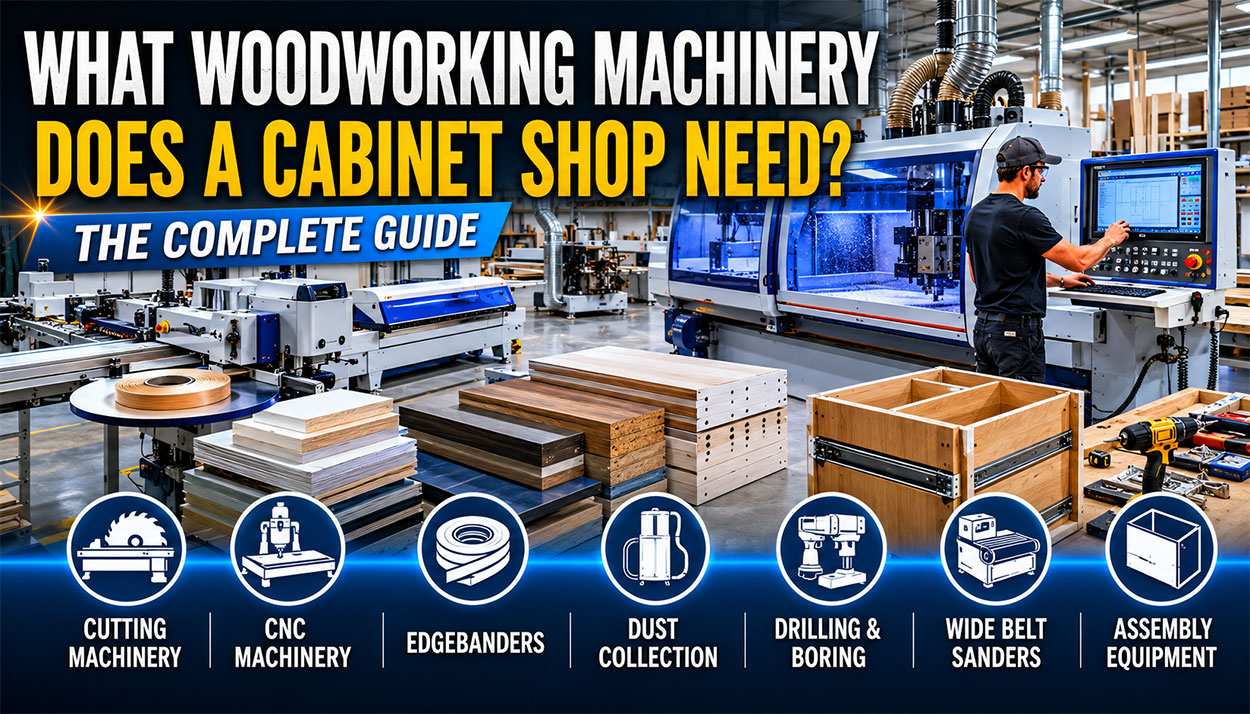
Woodworking machinery is the backbone of every profitable cabinet shop. Whether you're building kitchen cabinets, closets, office furniture, commercial millwork, or custom cabinetry, the right woodworking machinery determines how efficiently you can produce, how consistent your quality remains, and how quickly your business can grow.
Many cabinet shops reach a point where demand is no longer the problem.
Production is.
Jobs take too long.
Margins shrink.
Deadlines become harder to hit.
The solution is often not hiring more people.
The solution is investing in the right woodworking machinery equipment.
The most successful cabinet shops are built around efficient workflows. Every machine should remove a bottleneck, improve consistency, or reduce labor.
The question is not simply what woodworking machinery exists.
The question is what woodworking machinery a cabinet shop actually needs.
Quick Answer
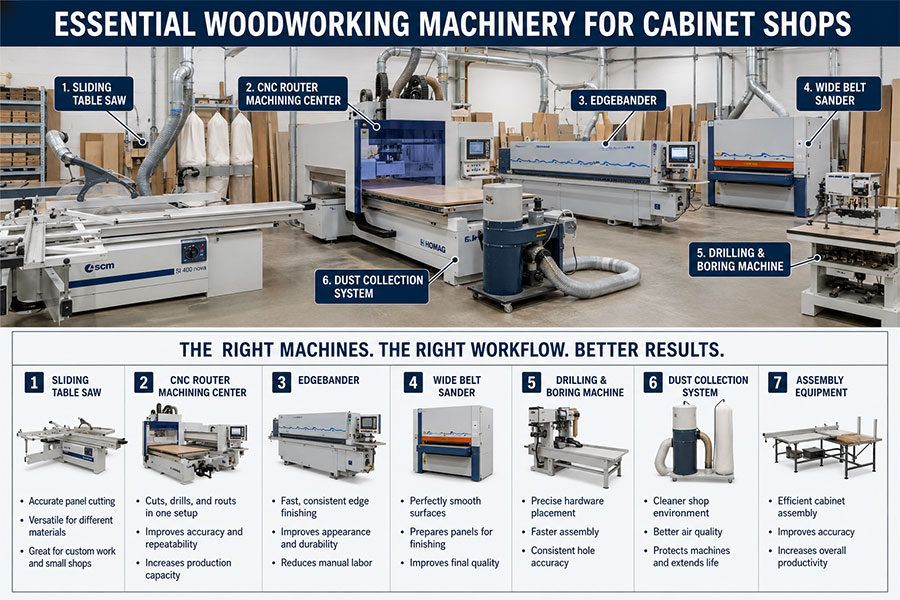
Most cabinet shops need the following woodworking machinery:
✓ Sliding Table Saw or Panel Saw
✓ CNC Router or CNC Machining Center
✓ Edgebander
✓ Dust Collection System
✓ Drilling & Boring Machine
✓ Wide Belt Sander
✓ Assembly Equipment
Smaller shops may begin with cutting, dust collection, and assembly equipment.
Growing shops typically add CNC machinery and edgebanders.
High-production shops often build around CNC woodworking machinery, automated panel processing, advanced edgebanding, and sanding systems.
Essential Woodworking Machinery Overview
| Machinery | >Purpose | Priority |
Sliding Table Saw |
Cutting sheet goods |
Essential |
Panel Saw |
High-volume sheet processing |
Essential |
CNC Router |
Cutting, routing, drilling |
Essential |
CNC Machining Center |
Automated production |
High Priority |
Edgebander |
Edge finishing |
Essential |
Dust Collection System |
Air quality & machine protection |
Essential |
Drilling & Boring Machine |
Hardware preparation |
Recommended |
Wide Belt Sander |
Surface finishing |
Recommended |
Assembly Equipment |
Cabinet construction |
Essential |
Why Woodworking Machinery Matters
A cabinet shop is a manufacturing business.
Every cabinet follows a production path:
Material arrives.
Panels are cut.
Parts are drilled.
Edges are finished.
Components are assembled.
Products are delivered.
If one stage slows down, the entire workflow slows down.
The right woodworking machinery helps:
✓ Increase production capacity
✓ Reduce labor costs
✓ Improve consistency
✓ Reduce material waste
✓ Improve product quality
✓ Shorten lead times
✓ Increase profitability
Without the proper equipment, growth often becomes difficult and expensive.
Cutting Machinery Every Cabinet Shop Needs
Most cabinet projects start with sheet goods.
That means cutting accuracy is critical.
Materials commonly processed include:
- MDF
- Melamine
- Plywood
- Veneered panels
- Particle board
- Composite materials
If cutting is inaccurate, every process that follows becomes more difficult.
Sliding Table Saw
A sliding table saw is often the first major woodworking machinery purchase for a cabinet shop.
It offers excellent accuracy and flexibility.
Benefits include:
✓ Precise cuts
✓ Lower initial investment
✓ Excellent versatility
✓ Strong value for smaller operations
Best suited for:
- Startup cabinet shops
- Small production shops
- Custom cabinet builders
- Businesses with limited floor space
Panel Saw
As production increases, many cabinet shops upgrade to a panel saw.
Panel saws process sheet goods faster and reduce labor requirements.
Best suited for:
- Growing cabinet manufacturers
- Commercial millwork shops
- High-volume production environments
Sliding Table Saw vs Panel Saw
| Feature | Sliding Table Saw | Panel Saw |
Initial Cost |
Lower |
Higher |
Floor Space |
Moderate |
Larger |
Throughput |
Moderate |
High |
Labor Efficiency |
Good |
Excellent |
Ideal Shop Size |
Small-Medium |
Medium-Large |
Sheet Processing Speed |
Good |
Excellent |
For many businesses, the decision depends on production volume rather than budget alone.
CNC Woodworking Machinery For Cabinet Production
CNC woodworking machinery is often the biggest productivity upgrade a cabinet shop can make.
Instead of relying on manual measuring, manual drilling, and repetitive setup work, CNC machinery automates many of these processes.
A CNC router can:
- Cut cabinet components
- Drill shelf pin holes
- Route grooves
- Machine hardware locations
- Create custom designs
- Produce repeatable parts
This improves both speed and consistency.
Benefits Of CNC Woodworking Machinery
✓ Higher production output
✓ Improved accuracy
✓ Less manual labor
✓ Reduced material waste
✓ Better repeatability
✓ Faster turnaround times
✓ Easier scaling
The larger the production volume, the more valuable CNC woodworking machinery becomes.
Manual Production vs CNC Production
| Category | Manual Workflow | CNC Workflow |
Labor Requirement |
High |
Lower |
Accuracy |
Operator Dependent |
Highly Consistent |
Setup Time |
Longer |
Shorter |
Repeatability |
Variable |
Excellent |
Production Capacity |
Limited |
Higher |
Material Waste |
Higher |
Lower |
For many cabinet shops, CNC machinery becomes the foundation of future growth.
Which Machinery Produces The Highest ROI?
Not all woodworking machinery delivers the same return.
Some equipment immediately removes bottlenecks.
Others improve quality or consistency.
| Machinery | Typical ROI Potential |
CNC Router |
Very High |
Edgebander |
Very High |
Panel Saw |
High |
Dust Collection System |
High |
Wide Belt Sander |
Moderate-High |
Drilling Machine |
Moderate |
Production Impact By Machinery Type
| Machinery | Estimated Productivity Improvement |
Manual Workflow |
█ |
Sliding Table Saw |
███ |
Panel Saw |
████ |
Edgebander |
█████ |
CNC Router |
███████ |
CNC Router + Edgebander |
█████████ |
Integrated Production Workflow |
██████████ |
The best investment is often the machine that removes the largest current bottleneck.
Why Edgebanders Are Essential Woodworking Machinery
Many cabinet shops start by applying edge tape manually.
That works when production volume is low.
Eventually it becomes a problem.
Manual edgebanding is slower.
Quality becomes inconsistent.
Labor costs increase.
An edgebander solves these issues.
Benefits Of Edgebanders
✓ Faster production
✓ Cleaner finished edges
✓ Better appearance
✓ Reduced labor
✓ Improved durability
✓ More consistent quality
Cabinet shops producing kitchens, closets, office furniture, and commercial millwork often see significant gains from adding an edgebander.
Manual Edgebanding vs Automatic Edgebanding
| Feature | Manual | Automatic Edgebander |
Speed |
Slow |
Fast |
Labor Requirement |
High |
Lower |
Consistency |
Variable |
Excellent |
Production Capacity |
Limited |
Higher |
Finish Quality |
Operator Dependent |
More Consistent |
For many businesses, an edgebander is one of the highest-return investments after CNC machinery.
Dust Collection Systems For Woodworking Machinery
Dust collection is one of the most overlooked pieces of woodworking machinery equipment.
Yet it affects nearly every aspect of production.
Dust impacts:
- Air quality
- Employee comfort
- Machine lifespan
- Product quality
- Maintenance costs
A proper dust collection system supports both people and machinery.
Benefits Of Dust Collection
✓ Cleaner work environment
✓ Improved air quality
✓ Reduced cleanup
✓ Better machine performance
✓ Longer equipment lifespan
✓ Improved finishing conditions
Dust collection should be considered essential infrastructure.
Not an optional upgrade.
Drilling And Boring Machinery
Cabinet shops drill thousands of holes every month.
Shelf pins.
Hinges.
Drawer slides.
Hardware locations.
Accuracy matters.
Drilling and boring machines improve consistency and reduce assembly problems.
Common applications include:
- Hinge boring
- Shelf pin drilling
- Dowel construction
- Hardware installation
- Drawer slide preparation
Dedicated drilling equipment remains valuable even in CNC-focused environments.
Wide Belt Sanders And Finishing Equipment
Poor surface preparation creates finishing problems.
Wide belt sanders improve consistency while reducing manual labor.
Benefits include:
✓ Better finish quality
✓ Reduced sanding time
✓ More consistent material thickness
✓ Faster workflow
✓ Improved production efficiency
For shops producing cabinet doors, decorative panels, and custom millwork, sanding equipment can significantly improve throughput.
What Woodworking Machinery Should A Cabinet Shop Buy First?
Not every cabinet shop needs every machine immediately.
Growth should happen strategically.
| Business Stage | Recommended Machinery |
Startup Shop |
Sliding Table Saw, Dust Collection, Assembly Equipment |
Growing Shop |
Edgebander, Drilling Equipment |
Expansion Stage |
CNC Router |
Production Shop |
CNC Automation, Panel Processing, Wide Belt Sander |
High-Volume Manufacturing |
Integrated Production Systems |
Buying machinery in the correct order often produces better ROI than buying everything at once.
New vs Used Woodworking Machinery
Many cabinet shops compare new woodworking machinery and used woodworking machinery.
Both options have advantages.
New vs Used Woodworking Machinery Comparison
| Category | New Woodworking Machinery | Used Woodworking Machinery |
Purchase Price |
Higher |
Lower |
Technology |
Latest |
Varies |
Warranty |
Typically Included |
Limited |
Automation Options |
More Advanced |
May Be Limited |
ROI Timeline |
Longer |
Faster |
Equipment Life |
Longer |
Depends On Condition |
When New Woodworking Machinery Makes Sense
✓ Long-term growth plans
✓ Higher production requirements
✓ Need for automation
✓ Desire for warranty coverage
When Used Woodworking Machinery Makes Sense
✓ Limited budget
✓ Faster ROI goals
✓ Access to premium brands
✓ Strategic expansion projects
Many successful cabinet shops operate with a combination of new and used woodworking machinery.
Common Woodworking Machinery Buying Mistakes
The wrong purchase can create expensive problems.
Common mistakes include:
X Buying based solely on price
X Ignoring future production growth
X Underestimating tooling costs
X Neglecting dust collection requirements
X Purchasing oversized equipment too early
X Buying machinery without service support
X Failing to train operators properly
X Ignoring workflow bottlenecks
The best woodworking machinery purchase is usually the one that solves the most expensive production problem.
Industries That Depend On Cabinet Shop Woodworking Machinery
Cabinet machinery supports more than kitchen cabinet production.
| Industry | Typical Machinery Requirements |
Kitchen Cabinets |
CNC, Edgebander, Panel Saw |
Closet Systems |
CNC, Drilling, Edgebanding |
Commercial Millwork |
CNC, Sanding, Panel Processing |
Retail Fixtures |
CNC, Routing, Finishing |
Office Furniture |
CNC, Edgebanding, Assembly |
Healthcare Casework |
Precision Drilling, CNC |
Hospitality Millwork |
CNC, Sanding, Edgebanding |
The machinery requirements vary, but the production principles remain similar.
Buying Considerations Before Purchasing Woodworking Machinery
Before investing in woodworking machinery, consider:
| Question | Why It Matters |
What is our biggest bottleneck? |
Helps prioritize purchases |
How much production volume do we handle? |
Determines equipment requirements |
Do we have sufficient floor space? |
Affects machine selection |
Do we have trained operators? |
Impacts implementation |
Can we access service and parts? |
Reduces downtime |
Are we planning to grow? |
Prevents underbuying |
These questions often determine which machine should be purchased first.
Final Thoughts
Making the decision to buy woodworking machinery is one of the most important investments a cabinet shop can make.
The right equipment increases production capacity, improves consistency, reduces labor requirements, and supports long-term growth.
Most successful cabinet shops eventually rely on:
✓ Sliding table saws or panel saws
✓ CNC woodworking machinery
✓ Edgebanders
✓ Dust collection systems
✓ Drilling equipment
✓ Sanding equipment
✓ Assembly systems
The goal is not to own the most machinery.
The goal is to build the most efficient workflow.
Many cabinet manufacturers work with suppliers such as Taurus Craco Machinery to source new woodworking machinery, used woodworking machinery, CNC equipment, edgebanders, dust collection systems, and production solutions that support long-term business growth.
FAQ
What woodworking machinery does a cabinet shop need first?
Most cabinet shops start with a sliding table saw, dust collection system, and assembly equipment before adding CNC machinery and edgebanders as production grows.
What is the most important woodworking machinery for a cabinet shop?
The most important woodworking machinery often includes cutting equipment, CNC machinery, edgebanders, and dust collection systems because they directly impact productivity and quality.
Is CNC woodworking machinery necessary for cabinet production?
Small shops can operate without CNC machinery, but growing cabinet manufacturers often consider CNC woodworking machinery essential for improving speed, accuracy, and repeatability.
Should I buy new or used woodworking machinery?
Both options can be effective. New woodworking machinery provides updated technology and warranty coverage, while used woodworking machinery can lower upfront costs and improve ROI.
Where can I buy woodworking machinery in Canada?
Cabinet shops can purchase woodworking machinery through experienced suppliers such as Taurus Craco Machinery that provide equipment selection, service support, tooling, parts, and long-term production guidance.